Build guide
Collar, small collar, light collar, phone radio, car monitor and home base. Written 2026-11-23 (US Central). Nothing here has been bought, built or tested.
The short version
- Four devices are drawn as finished shapes around store-bought boards: collar, phone radio, car monitor and home base. Each has print files, a parts list, wiring and assembly steps below.
- Two more collars were added the same day: a small collar for small dogs and a light collar with lights along the strap. Each is built in place of the collar, not as well as it.
- Battery life is now worked out from the parts' data sheets. It is not measured.
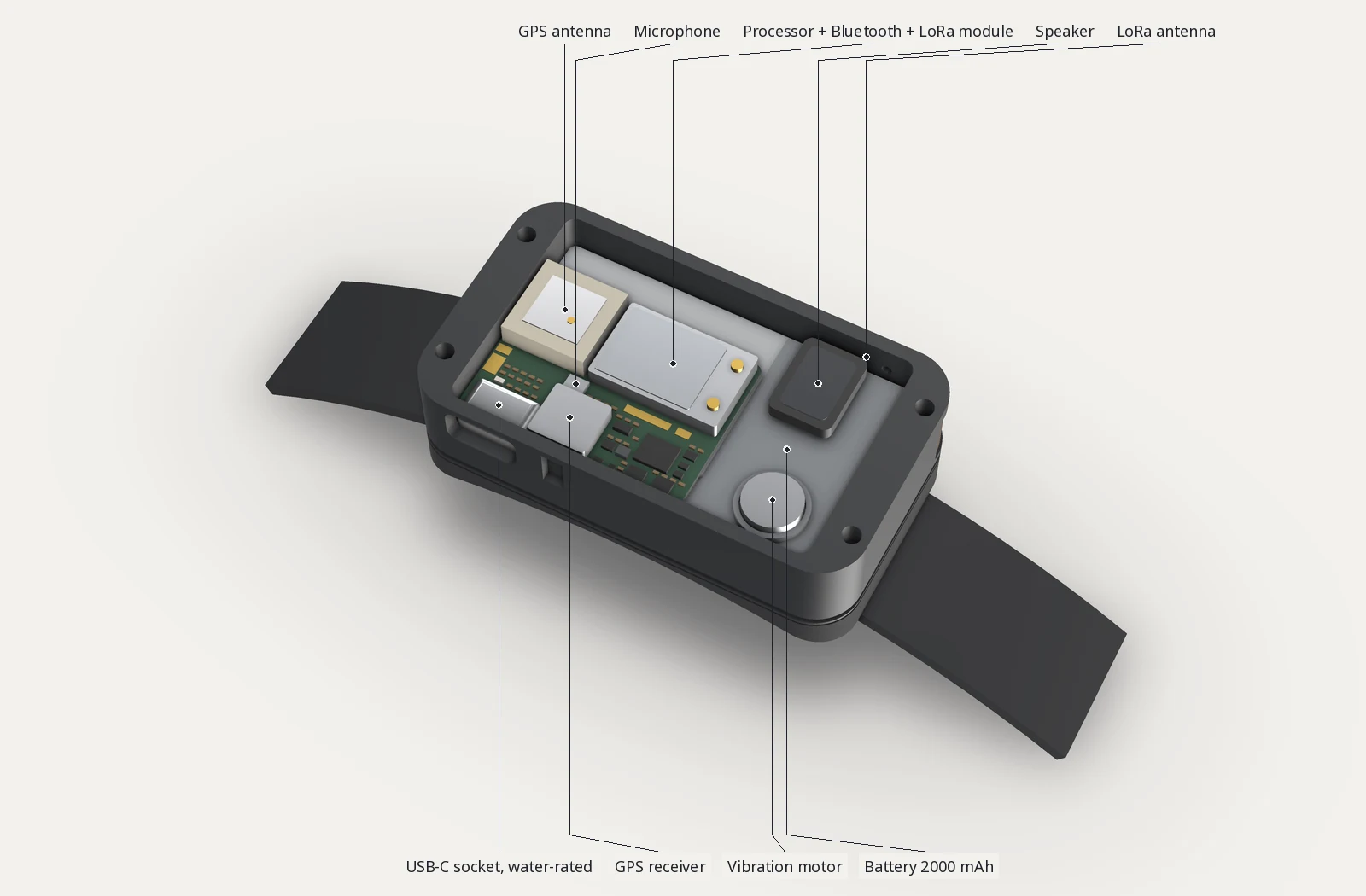
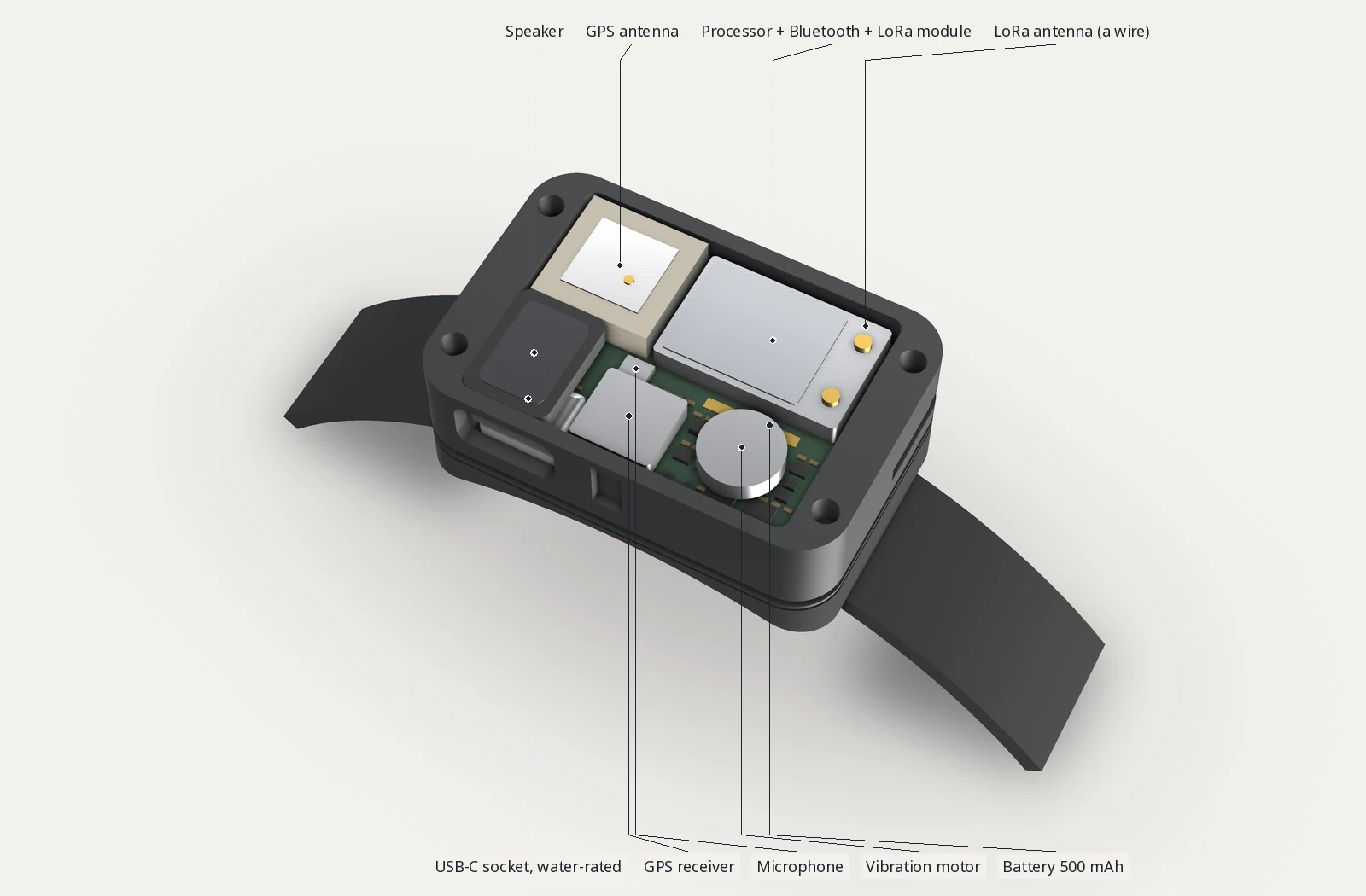
- A custom board is designed as far as parts, placement and connections, with the makers who could build it. Its layout is not drawn. Two collars are drawn round it.
- An antenna test collar takes five antennas to compare on the dog.
- The website has a How to use page; back to the website.
- The print files and the custom board's files are not on this website.
- Parts for one collar, phone radio, car monitor and home base come to about $191 before shipping, tax, filament and the packs some small parts only sell in.
- The list of what is not checked is near the end. Read it before ordering.
The look
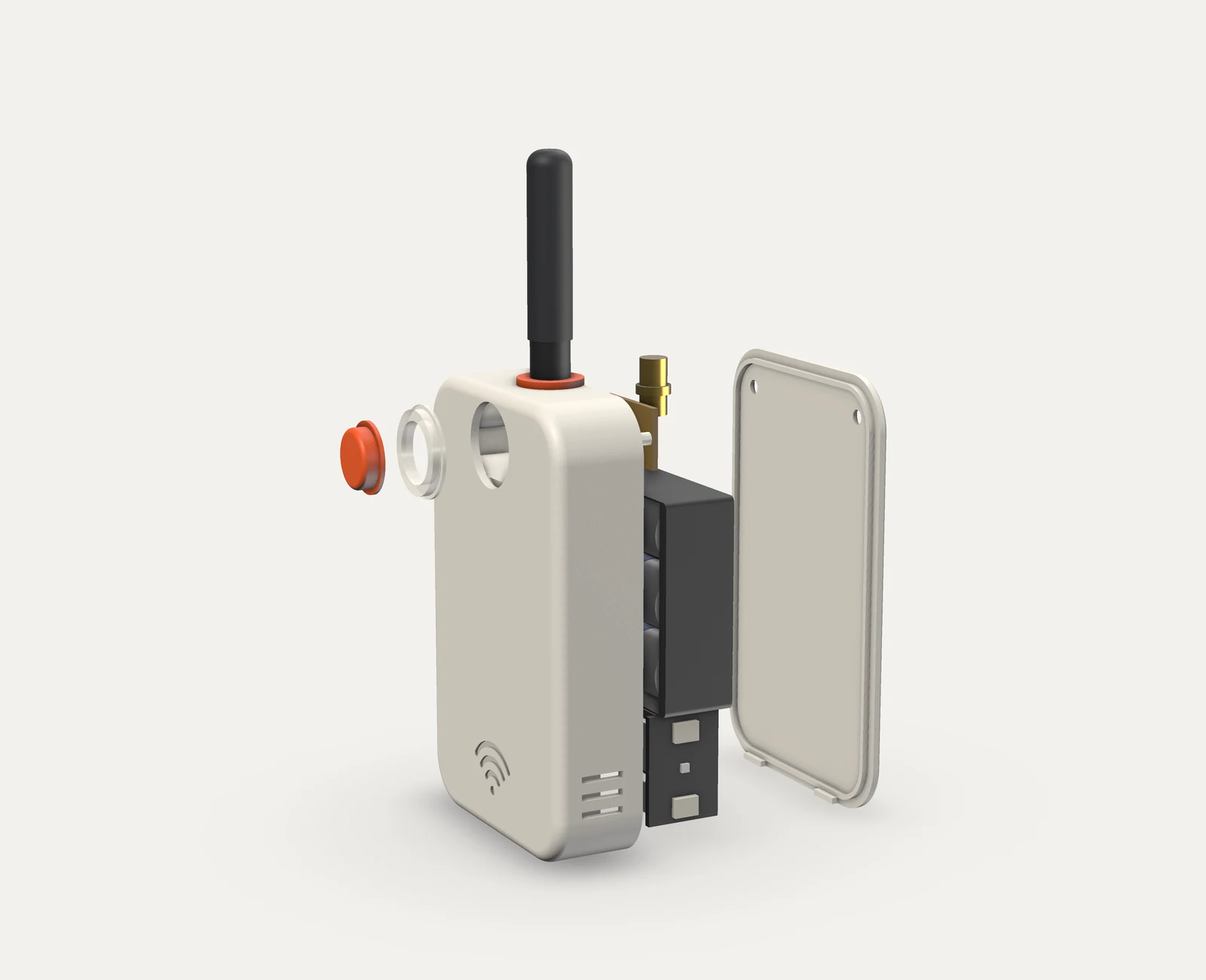
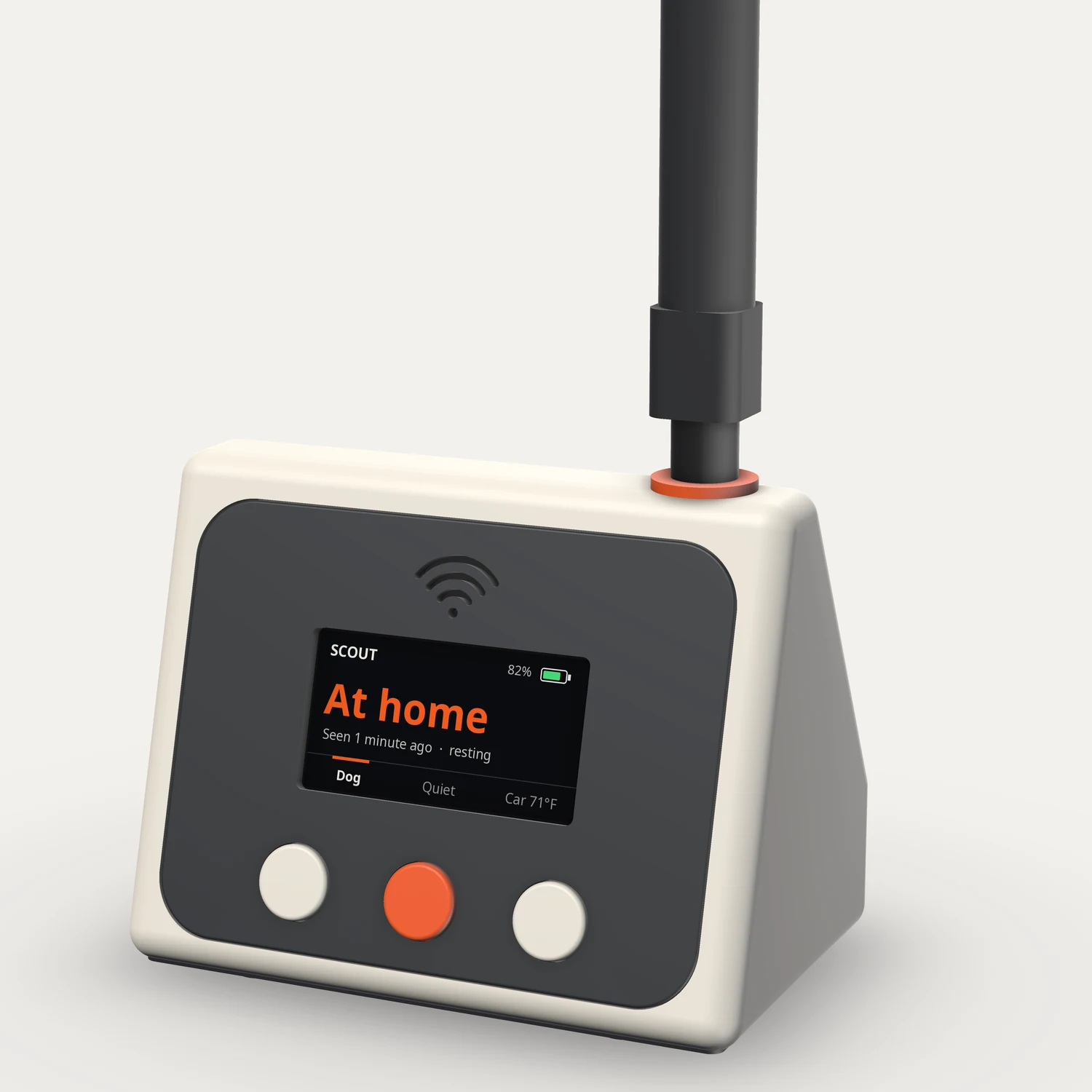
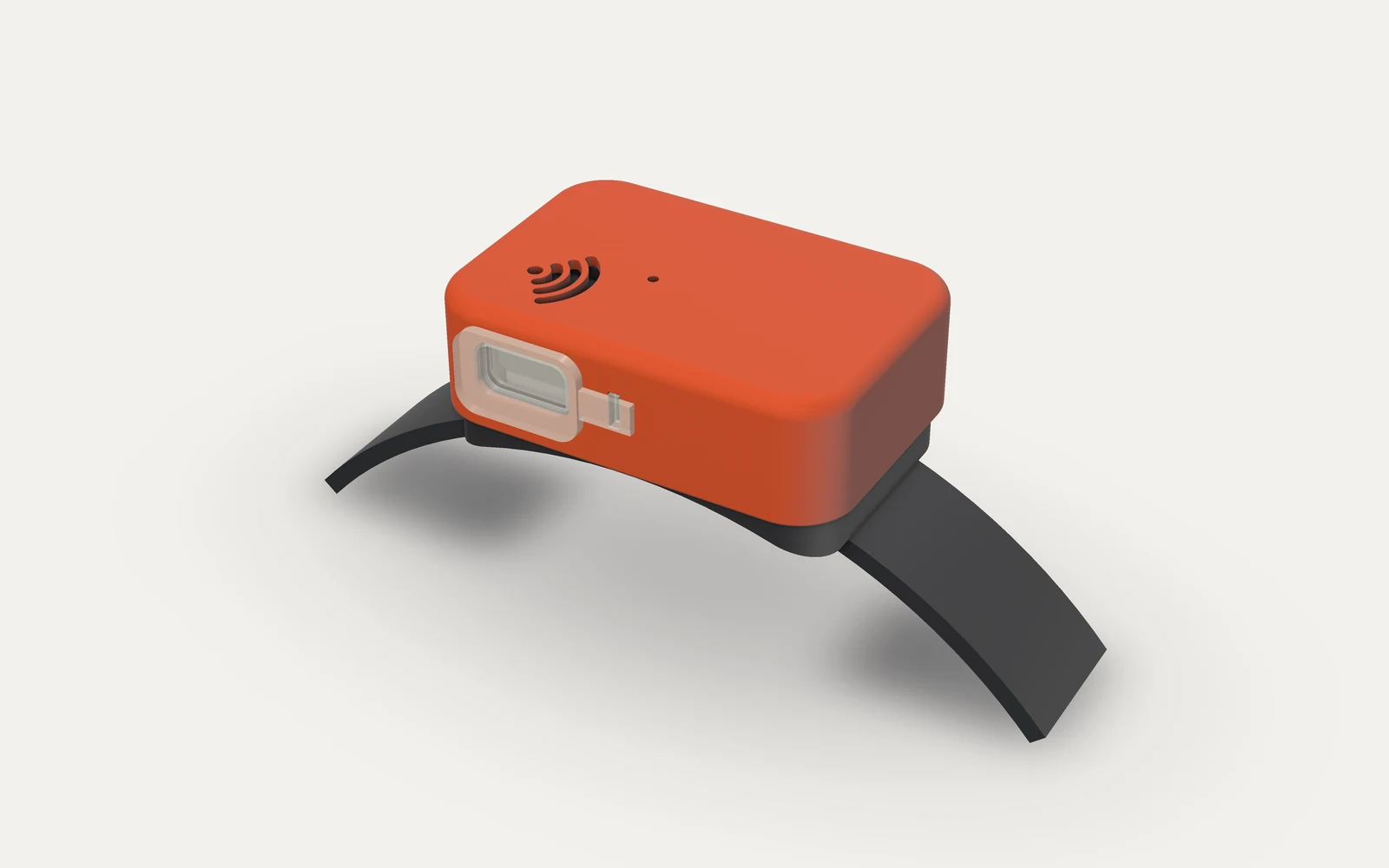
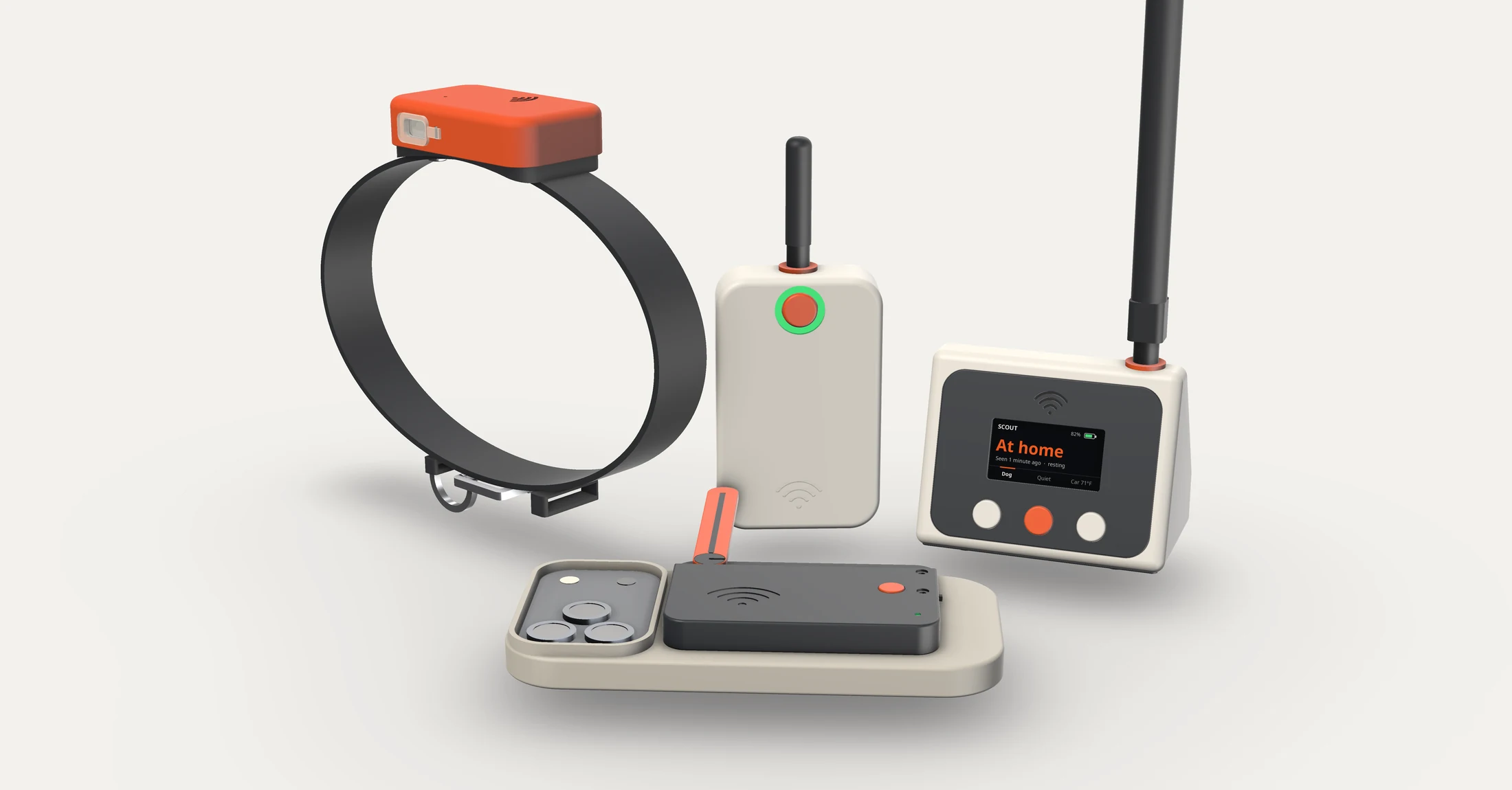
Three colors across the family. Blaze orange for the collar's bumper and for every button and antenna ring. Slate for hard shells. Bone white for the two devices that sit in the sun or in the house. One mark, a dot with three arcs, is the sound opening on the collar, the vent on the car monitor, the buzzer opening on the home base, and the logo.
This is the list to buy from.
| Part | Shop | How many | Cost | Used in |
|---|
| Molex 1052620001 flexible antenna | DigiKey | 1 | $4.65 | collar |
| Keystone 2465 holder for 3 AA cells | DigiKey or Mouser | 1 | $2.00 | car monitor |
| Short 915 MHz antenna, SMA (TE/Linx ANT-916-CW-RH-SMA) | DigiKey or Mouser | 1 | $8.00 | car monitor |
| Same Sky CMS-151125-078SP-67 speaker | Mouser or DigiKey | 1 | $2.99 | collar |
| Adafruit 1201 vibration motor | adafruit.com | 1 | $1.95 | collar |
| Adafruit 160 piezo buzzer | adafruit.com | 1 | $1.50 | home base |
| Adafruit 2130 amplifier (PAM8302) | adafruit.com | 1 | $3.95 | collar |
| Adafruit 258 LiPo battery, 1200 mAh | adafruit.com | 2 | $19.90 | collar, phone radio |
| Adafruit 5776 sensor board (SHT41) | adafruit.com | 1 | $5.95 | car monitor |
| Adafruit 805 slide switch | adafruit.com | 1 | $0.95 | phone radio |
| Adafruit 851 SMA-to-U.FL lead | adafruit.com | 2 | $7.90 | car monitor, home base |
| Push button switch, 6 x 6 x 5 mm (Adafruit 367) | adafruit.com | 1 | $0.13 | phone radio; sold as 20 for $2.50; out of stock when checked |
| Push button switches 6 x 6 x 5 mm (3) | adafruit.com | 1 | $0.38 | home base; from the same pack of 20 |
| USB-C socket board (Adafruit 4090) | adafruit.com | 1 | $2.95 | home base |
| Brass heat-set inserts M2 x 3 (2); screws M2 x 6 flat head (2) | cnckitchen.store | 1 | $0.50 | phone radio |
| Brass heat-set inserts M2 x 3 (4), M3 x 5.7 (4); screws M2 x 6 (4), M3 x 8 (4) | cnckitchen.store | 1 | $1.20 | home base |
| Brass heat-set inserts M3 x 5.7 (2); screws M3 x 8 (2) | cnckitchen.store | 1 | $0.50 | car monitor |
| Brass heat-set inserts: M2 x 3 (4), M3 x 5.7 (2) | cnckitchen.store | 1 | $0.60 | collar; sold as 100 for about EUR 9.90 a size |
| Heltec Vision Master T190, 902-928 MHz | heltec.org | 1 | $19.00 | home base |
| PCB Artists IP67 acoustic membrane | pcbartists.com | 1 | $1.00 | collar; sold as 20 for $19.99 |
| ALFA ARS-915P antenna | rokland.com | 1 | $11.97 | home base |
| Seeed L76K GNSS module for XIAO | seeedstudio.com | 1 | $10.90 | collar |
| Seeed Wio-SX1262 for XIAO | seeedstudio.com | 1 | $5.09 | collar |
| Seeed XIAO nRF52840 + Wio-SX1262 kit | seeedstudio.com | 2 | $26.98 | phone radio, car monitor |
| Seeed XIAO nRF52840 Sense | seeedstudio.com | 1 | $15.90 | collar |
| BioThane Beta 520 strap, 1 in, 2.5 ft | strapworks.com | 1 | $3.93 | collar |
| 1N5817 diode | taydaelectronics.com | 1 | $0.06 | car monitor |
| TotalElement magnet ring with alignment magnet, 54.1 x 46 x 1.5 mm | totalelement.com | 1 | $5.00 | phone radio; sold as 5 for $24.99 |
| Weaver #49 stainless roller buckle, 1 in | weaverleathersupply.com | 1 | $4.90 | collar |
| D-ring and strap keeper, 1 in | any hardware or electronics shop | 1 | $2.00 | collar |
| Hook-and-loop strap, 25 mm x 30 cm | any hardware or electronics shop | 1 | $1.00 | car monitor |
| Push button switch 6 x 6 x 5 mm; red/green two-colour light, 3 mm; resistor | any hardware or electronics shop | 1 | $1.00 | car monitor |
| Screws: M2 x 6 flat head (4), M3 x 12 low head (2) | any hardware or electronics shop | 1 | $1.00 | collar |
| Sensor cable (JST-SH 4 pin to bare wires) | any hardware or electronics shop | 1 | $0.95 | car monitor |
| Silicone cord, 1.5 mm, 25 cm | any hardware or electronics shop | 1 | $1.00 | collar |
| Small electronic parts | any hardware or electronics shop | 1 | $2.00 | collar |
| Strip of prototyping board, wire, 4 stick-on rubber feet | any hardware or electronics shop | 1 | $2.00 | home base |
| U.FL lead with a bare end, 100 mm; 16 cm of 0.8 mm copper wire | any hardware or electronics shop | 1 | $2.00 | phone radio |
| Energizer Ultimate Lithium AA (L91), 3 cells | any store | 1 | $7.00 | car monitor |
| Total for one of each device | | | $190.68 | before shipping and tax; packs and filament are extra |
Collar
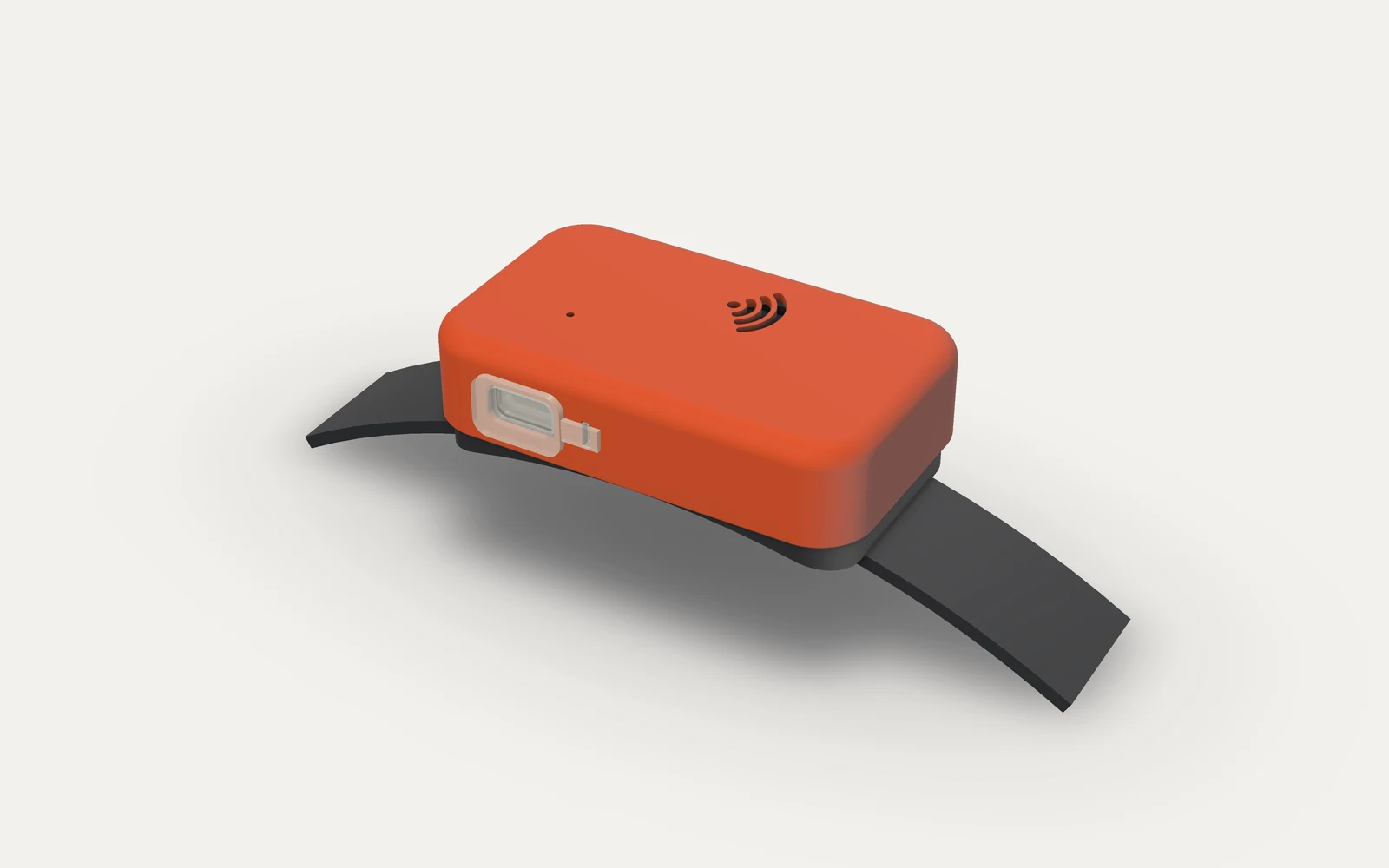
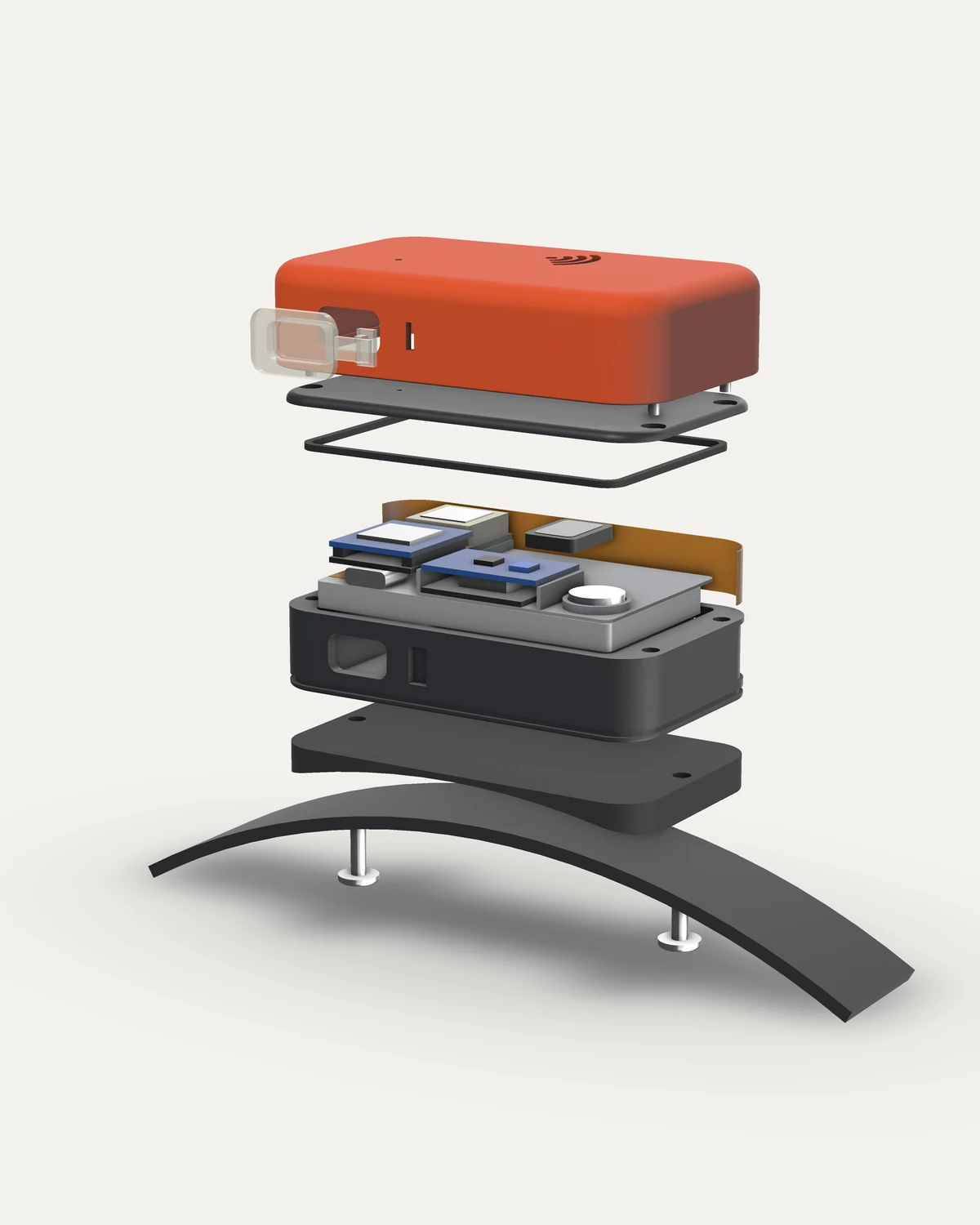
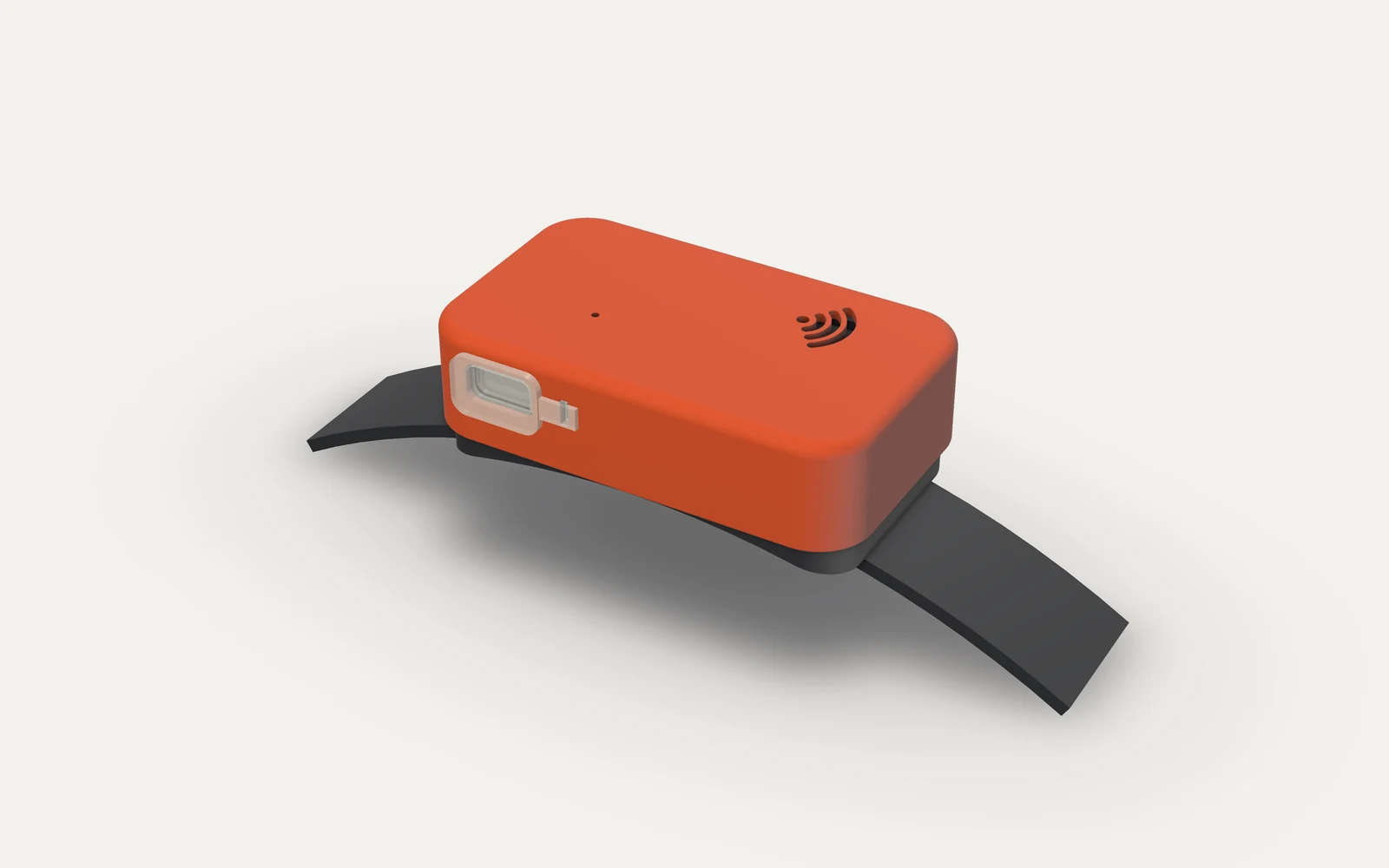
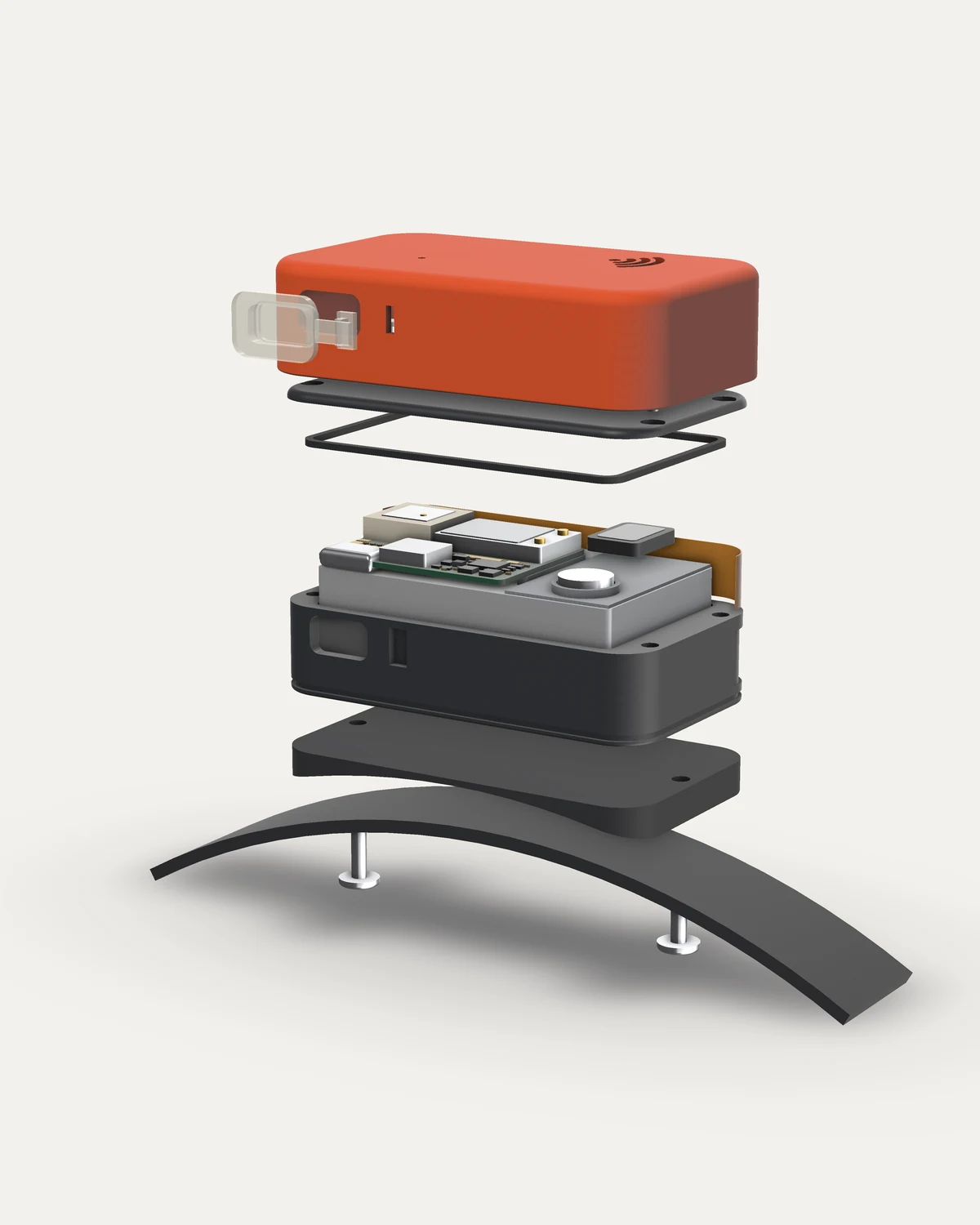
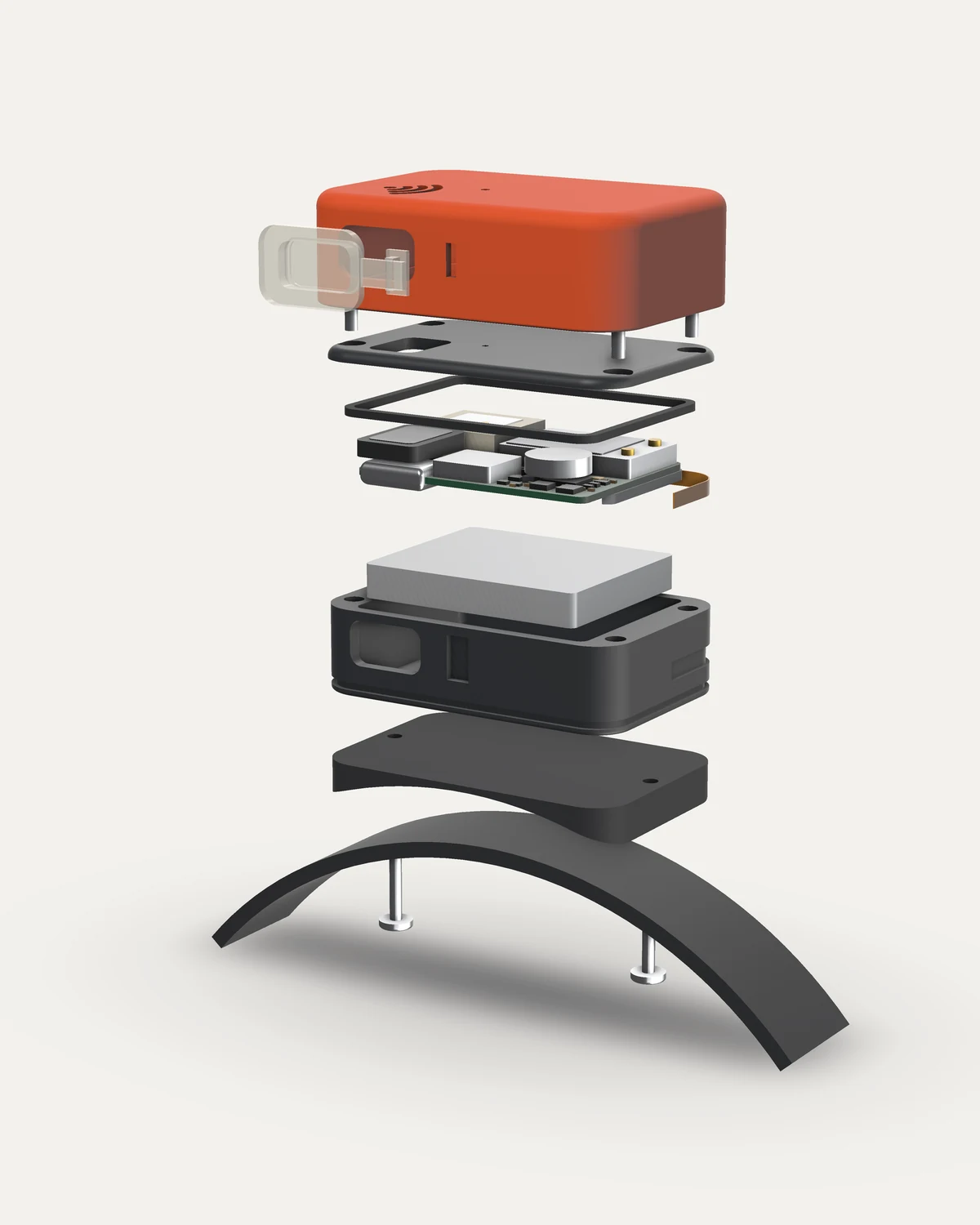
The collar is one sealed box on a strap. It follows the last prototype (the small tracker), with the large battery, recorded voice, and the sizes the part checks brought back.
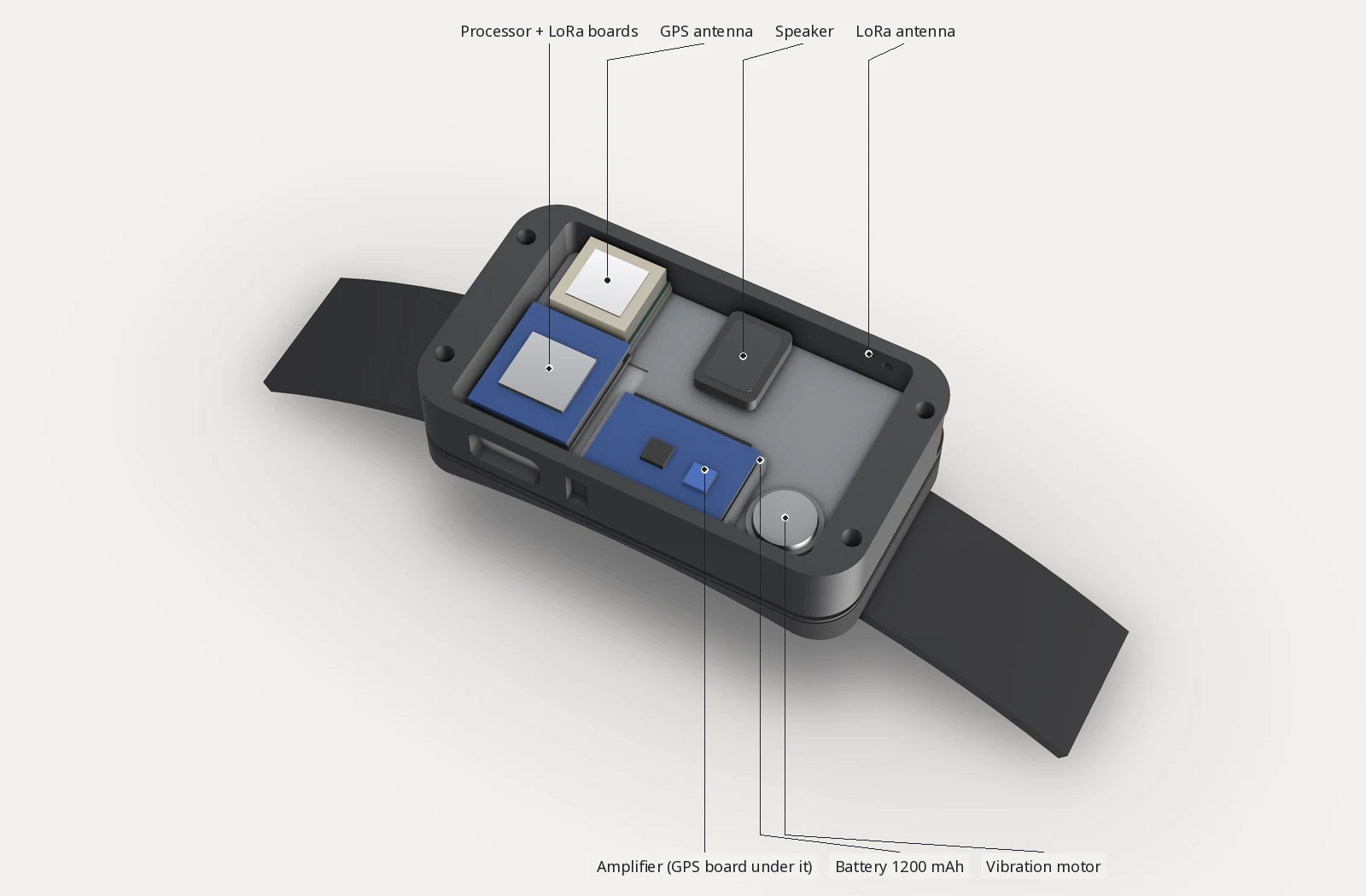
- The battery lies flat on the floor and everything else sits on a printed carrier above it. That keeps the box 78 mm long instead of 94.
- The two boards sit upside down so the charging socket lands low in the wall, clear of the lid.
- The speaker is a small one that is water-rated on its face. It is glued under a window in the lid, so the speaker itself keeps the water out.
- The LoRa antenna is a stick-on strip in a band round the outside of the hard box, under the bumper. The same band takes a hand-laid wire.
- Sound comes from one pin through a small amplifier. The amplifier's power is switched off between sounds, because its board draws 0.5 mA even when shut down.
Parts to buy
| Part | What it does | Size | Cost | How sure |
|---|
| Seeed XIAO nRF52840 Sense | Processor, Bluetooth, motion sensor, microphone | 21 x 17.8 mm | $15.90 | read on the seller's page |
| Seeed Wio-SX1262 for XIAO | LoRa radio; plugs under the processor board | stack about 22 x 23 x 8 mm (Seeed gives no drawing) | $5.09 | read on the seller's page |
| Seeed L76K GNSS module for XIAO | GPS; comes with its ceramic antenna on a 10 cm lead | 18 x 21 mm; antenna size not published | $10.90 | read on the seller's page |
| Adafruit 258 LiPo battery, 1200 mAh | Battery with protection circuit | 34 x 62 x 5 mm, 23 g | $9.95 | read on the seller's page |
| Adafruit 2130 amplifier (PAM8302) | Drives the speaker for recorded voice | 15 x 24 x 2 mm | $3.95 | read on the seller's page |
| Same Sky CMS-151125-078SP-67 speaker | Speaker, water-rated on its front face (maker: IPX7 front side) | 15 x 11 x 2.5 mm, 8 ohm, 0.7 W | $2.99 | price seen second-hand |
| Adafruit 1201 vibration motor | Vibration | 10 mm across, 2.7 mm thick | $1.95 | read on the seller's page |
| Molex 1052620001 flexible antenna | LoRa antenna, sticks into the band on the outside of the box | 79 x 10 x 0.1 mm, 100 mm lead | $4.65 | price seen second-hand |
| PCB Artists IP67 acoustic membrane | Keeps water out of the microphone hole | 8 mm disc; hole under it 3 mm or less | $1.00 | read on the seller's page; sold as 20 for $19.99 |
| Brass heat-set inserts: M2 x 3 (4), M3 x 5.7 (2) | Threads for the lid and strap screws | holes 3.2 and 4.0 mm | $0.60 | read on the seller's page; sold as 100 for about EUR 9.90 a size |
| Screws: M2 x 6 flat head (4), M3 x 12 low head (2) | Lid and strap | | $1.00 | not checked; my estimate |
| Silicone cord, 1.5 mm, 25 cm | Seal between lid and box | | $1.00 | not checked; my estimate |
| Small electronic parts | One switch transistor for the amplifier's power, one transistor and diode for the motor, resistors | | $2.00 | not checked; my estimate |
| BioThane Beta 520 strap, 1 in, 2.5 ft | The collar strap | 2.5 mm thick | $3.93 | read on the seller's page |
| Weaver #49 stainless roller buckle, 1 in | Buckle | | $4.90 | read on the seller's page |
| D-ring and strap keeper, 1 in | Leash ring | | $2.00 | not checked; my estimate |
| Total | | | $71.81 | for the amounts used in one device; packs cost more |
Options:
- 1.5 in strap and buckle: Wider strap for a big dog: Weaver #49 buckle 1.5 in is $6.70; a by-the-foot price for 1.5 in Beta 520 was not found.
Parts to print
| File (.step and .stl) | Material | Color | Grams | Size, mm | How to lay it on the bed |
|---|
collar-tray | PETG | slate | 16.2 | 77.6 × 44.2 × 15.2 | Open side up. No supports. |
collar-lid | PETG | slate | 5.5 | 77.6 × 44.2 × 1.8 | Outside face down on a textured plate. |
collar-carrier | PETG | grey | 1.4 | 62.2 × 38.8 × 4.8 | Flat side down. |
collar-bumper | TPU | blaze orange | 13.8 | 81.2 × 47.8 × 18.8 | Top face down. No supports. 95A TPU. |
collar-neck-pad | TPU | slate | 10.9 | 77.8 × 44.4 × 6.4 | Flat side down. |
collar-port-plug | TPU clear | clear | 0.8 | 24.5 × 5.3 × 11.6 | Cap face down. Clear or natural TPU so the charge light shows. |
| Total | | | 48.6 | | |
Inside
Wiring
| Pin on the board | Goes to |
|---|
| D0 | GPS board: standby |
| D1, D2, D3, D4, D5 | LoRa board (plugs in): signal, reset, busy, select, antenna switch |
| D6 | Amplifier's power switch transistor. This pin used to send settings to the GPS; the GPS now runs on its factory settings. |
| D7 | GPS board: data in |
| D8, D9, D10 | LoRa board (plugs in): data lines |
| NFC1 pad (underside) | Vibration motor, through a transistor and a diode |
| NFC2 pad (underside) | Sound out to the amplifier's A+ input, through a 1 k resistor and a 10 nF capacitor to ground; A- to ground |
| BAT+ and BAT- pads | Battery |
| Amplifier output | Speaker |
| On the board | Motion sensor and microphone; no wiring |
Assembly
- Test the seal first, with nothing inside. Press the cord into the lid's groove, put a tissue in the box, screw the lid on, fit the plug, and hold it under water for 30 minutes. Dry tissue means go on.
- Press the brass inserts in with a soldering iron: four M2 into the top of the box's ends, two M3 into its underside.
- Stick the LoRa antenna into the shallow band on the outside of the box, on the side away from the charging opening. Pass its lead through the small hole and seal the hole with glue.
- Solder the wiring in the table below. Keep leads short.
- Lay the battery in. Set the grey carrier on it. Seat the two boards upside down, charging socket in the opening. Put the GPS board between the posts with the amplifier on top, the motor in its ring, and the GPS antenna on its stand, face up.
- Glue the speaker under the lid's window, face out, with a full bead of silicone round it. Stick a membrane disc over the microphone hole on the inside of the lid.
- Screw the lid down with four M2 screws. Pull the bumper on. Push the head of the plug's leash through its slot, then press the plug in.
- Punch two 3.5 mm holes in the strap, 70.4 mm apart. Screw through the strap and the neck pad into the box with two M3 x 12 screws.
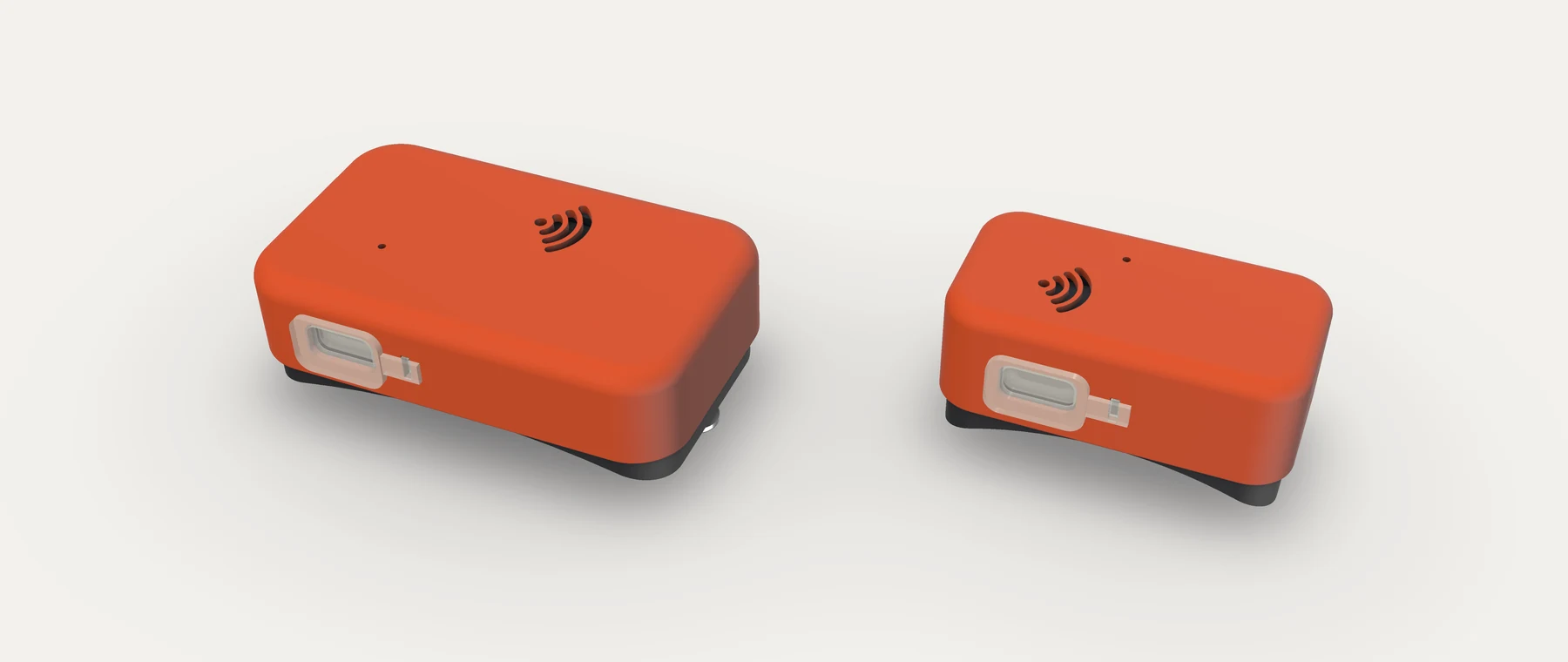
Small collar
The small collar does everything the collar does, in a box about half the size, for small dogs.
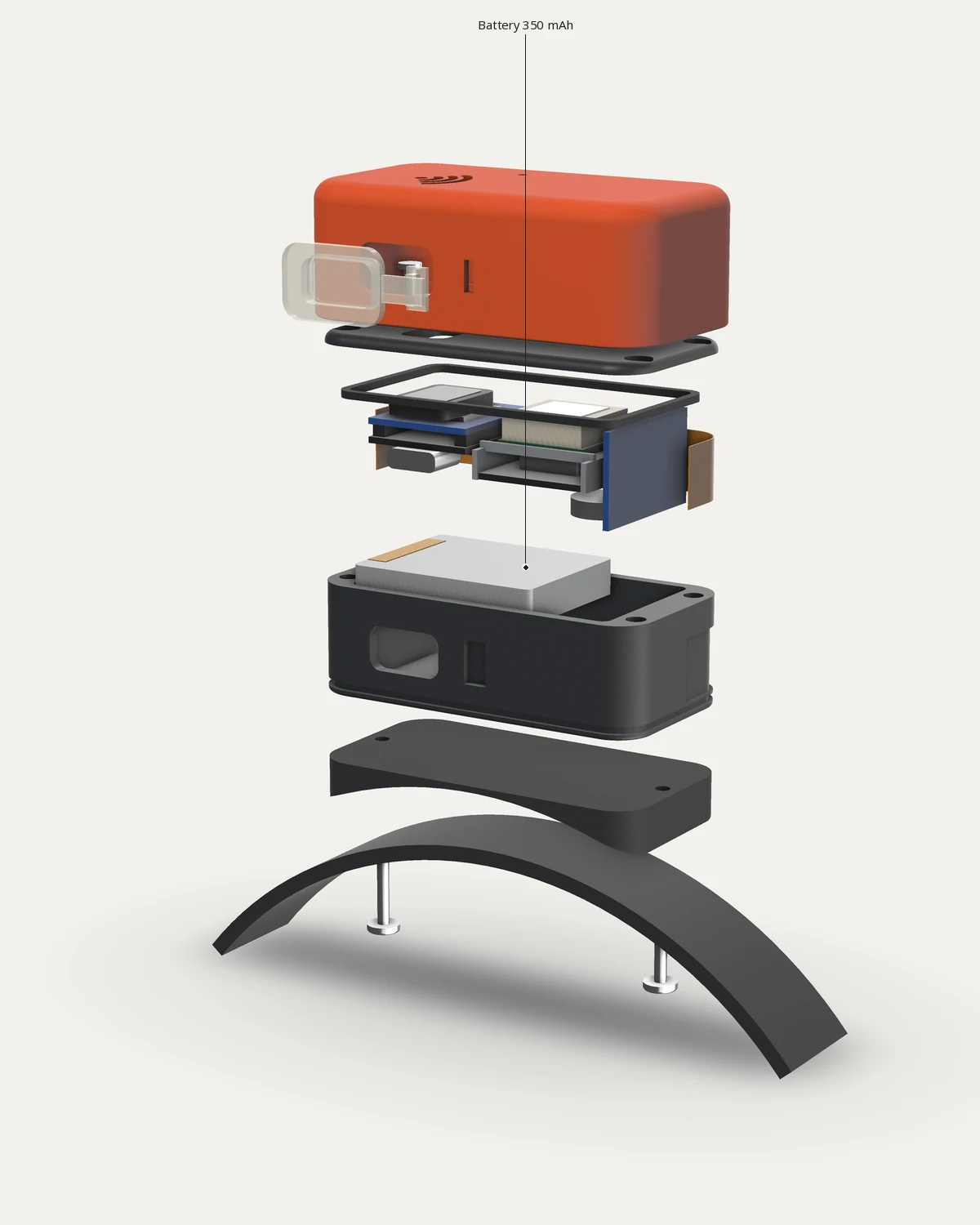
- The boards sit on top of the battery, not beside it. That is the only way to make the box this short with store-bought boards. The price is thickness: it is 2 mm thicker than the collar.
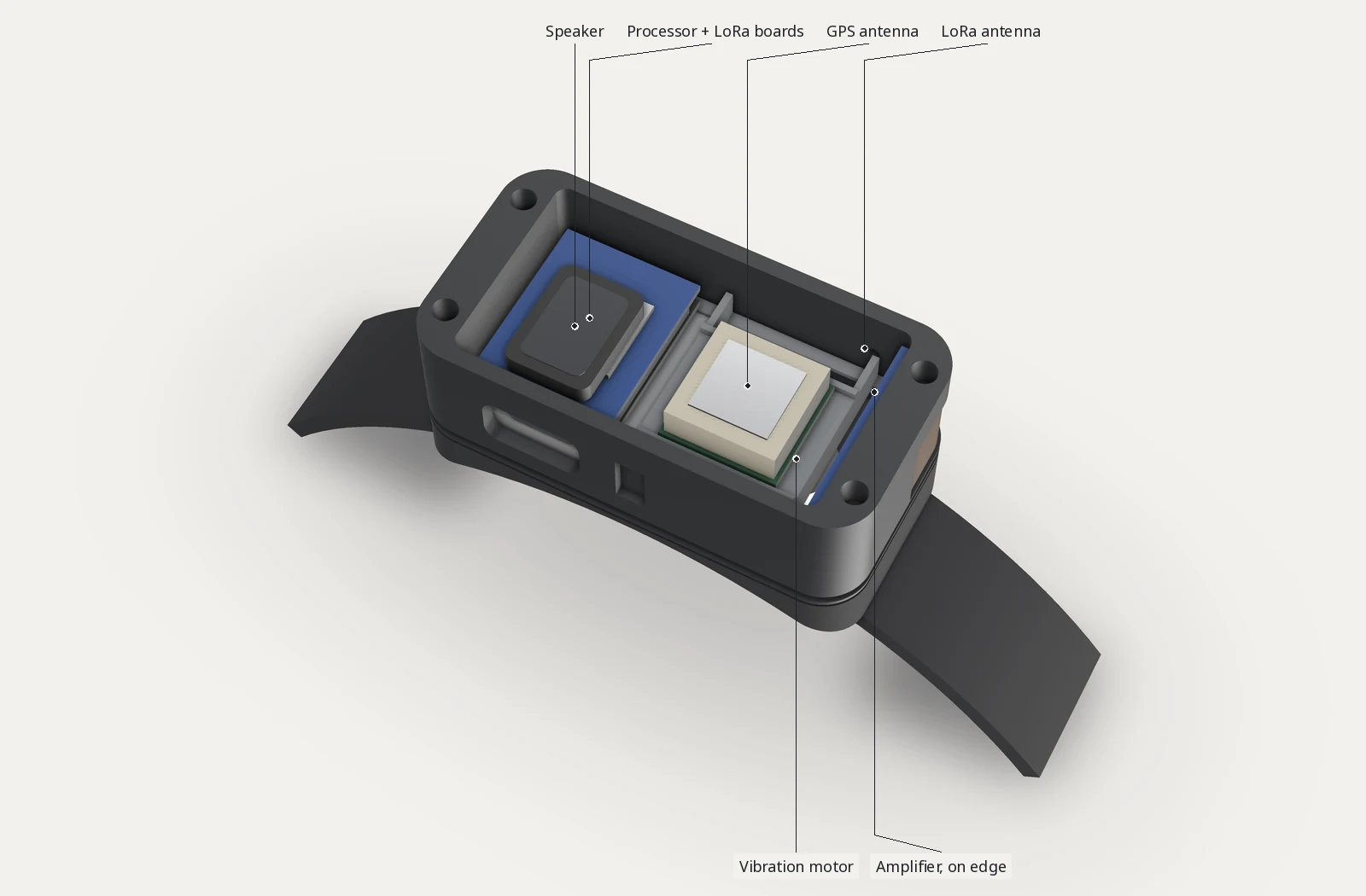
- The GPS antenna sits on a shelf above the GPS board. The speaker sits above the processor boards. The amplifier stands on edge against one end wall. The motor is on the floor beside the battery.
- The battery is Adafruit's 350 mAh cell. Its data sheet allows a larger cell than its shop page states, and the box is sized for the data sheet. A 420 mAh cell (Adafruit 4236) needs a box 5 mm longer.
- It uses M2 screws throughout, on a 3/4 inch strap. The neck pad is curved for a smaller neck.
- Who it fits is my estimate, not a tested limit: dogs from about 12 lb, necks from about 11 inches. At 12 lb the box is about 1 percent of the dog's weight, the same share as Tractive's stated minimum for its dog tracker.
Parts to buy
| Part | What it does | Size | Cost | How sure |
|---|
| Seeed XIAO nRF52840 Sense | Processor, Bluetooth, motion sensor, microphone | 21 x 17.8 mm | $15.90 | read on the seller's page |
| Seeed Wio-SX1262 for XIAO | LoRa radio; plugs under the processor board | stack about 22 x 23 x 8 mm (Seeed gives no drawing) | $5.09 | read on the seller's page |
| Seeed L76K GNSS module for XIAO | GPS; comes with its ceramic antenna on a 10 cm lead | 18 x 21 mm; antenna size not published | $10.90 | read on the seller's page |
| Adafruit 4237 LiPo battery, 350 mAh | Battery with protection circuit | shop page: 32.5 x 25 x 5 mm, 7 g; its data sheet allows up to 32.5 x 25.5 x 5.7 mm, and the box is sized for that | $5.95 | read on the seller's page |
| Adafruit 2130 amplifier (PAM8302) | Drives the speaker for recorded voice | 15 x 24 x 2 mm | $3.95 | read on the seller's page |
| Same Sky CMS-151125-078SP-67 speaker | Speaker, water-rated on its front face (maker: IPX7 front side) | 15 x 11 x 2.5 mm, 8 ohm, 0.7 W | $2.99 | price seen second-hand |
| Adafruit 1201 vibration motor | Vibration | 10 mm across, 2.7 mm thick | $1.95 | read on the seller's page |
| Molex 1052620001 flexible antenna | LoRa antenna, sticks into the band on the outside of the box; on this shorter box it wraps round both ends | 79 x 10 x 0.1 mm, 100 mm lead | $4.65 | price seen second-hand |
| PCB Artists IP67 acoustic membrane | Keeps water out of the microphone hole | 8 mm disc; hole under it 3 mm or less | $1.00 | read on the seller's page; sold as 20 for $19.99 |
| Brass heat-set inserts: M2 x 3 (6) | Threads for the lid and strap screws | holes 3.2 mm, at least 4 mm deep | $0.40 | read on the seller's page; sold as 100 for about EUR 9.90 a size |
| Screws: M2 x 6 flat head (4), M2 x 12 pan head with washers (2) | Lid and strap | | $1.00 | not checked; my estimate |
| Silicone cord, 1.5 mm, 18 cm | Seal between lid and box | | $1.00 | not checked; my estimate |
| Small electronic parts | One switch transistor for the amplifier's power, one transistor and diode for the motor, resistors | | $2.00 | not checked; my estimate |
| BioThane Beta 520 strap, 3/4 in, 2 ft | The collar strap | about 2.5 mm thick | $2.62 | read on the seller's page |
| Weaver #49 stainless roller buckle, 3/4 in | Buckle | 22 g | $3.60 | read on the seller's page; out of stock on the day I checked |
| Weaver #3250 stainless D-ring, 3/4 in | Leash ring | 7 g | $1.00 | read on the seller's page |
| Strap keeper, 3/4 in | Holds the loose end of the strap | | $1.00 | not checked; my estimate |
| Total | | | $65.00 | for the amounts used in one device; packs cost more |
Parts to print
| File (.step and .stl) | Material | Color | Grams | Size, mm | How to lay it on the bed |
|---|
small-collar-tray | PETG | slate | 9.7 | 58.0 × 29.9 × 17.9 | Open side up. No supports. |
small-collar-lid | PETG | slate | 2.5 | 58.0 × 29.9 × 1.8 | Outside face down on a textured plate. |
small-collar-carrier | PETG | grey | 0.4 | 43.6 × 25.3 × 5.6 | Flat side down. The shelf is a short bridge; no supports. |
small-collar-bumper | TPU | blaze orange | 7.8 | 61.0 × 32.9 × 21.2 | Top face down. No supports. 95A TPU. |
small-collar-neck-pad | TPU | slate | 5.8 | 58.0 × 29.9 × 7.3 | Flat side down. |
small-collar-port-plug | TPU clear | clear | 0.7 | 24.4 × 4.6 × 11.6 | Cap face down. Clear or natural TPU so the charge light shows. |
| Total | | | 26.9 | | |
Inside
Wiring
| Pin on the board | Goes to |
|---|
| D0 | GPS board: standby |
| D1, D2, D3, D4, D5 | LoRa board (plugs in): signal, reset, busy, select, antenna switch |
| D6 | Amplifier's power switch transistor. This pin used to send settings to the GPS; the GPS now runs on its factory settings. |
| D7 | GPS board: data in |
| D8, D9, D10 | LoRa board (plugs in): data lines |
| NFC1 pad (underside) | Vibration motor, through a transistor and a diode |
| NFC2 pad (underside) | Sound out to the amplifier's A+ input, through a 1 k resistor and a 10 nF capacitor to ground; A- to ground |
| BAT+ and BAT- pads | Battery |
| Amplifier output | Speaker |
| On the board | Motion sensor and microphone; no wiring |
Assembly
- Test the seal first, with nothing inside, as for the collar: cord in the lid's groove, a tissue in the box, lid screwed on, plug fitted, 30 minutes under water.
- Press six M2 brass inserts in with a soldering iron: four into the top of the box's ends, two into its underside.
- Stick the LoRa antenna into the shallow band on the outside of the box, on the side away from the charging opening. On this box it wraps round both corners and about 7 mm onto each end. Pass its lead through the small hole and seal the hole with glue.
- Solder the wiring in the table below. Keep leads short.
- Stick the motor to the floor at the end away from the charging opening. Stand the amplifier on edge against that end wall, behind the low rib. Lay the battery in beside the motor.
- Seat the two boards upside down on the battery, charging socket in the opening. Lay the GPS board on the battery next to them. Lower the grey comb over both: its two rails sit either side of the GPS board. Set the GPS antenna on the comb's shelf, face up.
- Glue the speaker under the lid's window, face out, with a full bead of silicone round it. It sits just above the boards. Stick a membrane disc over the microphone hole on the inside of the lid.
- Screw the lid down with four M2 screws. Pull the bumper on. Push the head of the plug's leash through its slot, then press the plug in.
- Punch two 2.5 mm holes in the strap, 52.2 mm apart. Screw through the strap and the neck pad into the box with two M2 x 12 screws and washers.
Light collar
The light collar is the collar with lights along the strap. The lights show white toward the ground and a dim color elsewhere, and every part is housed.
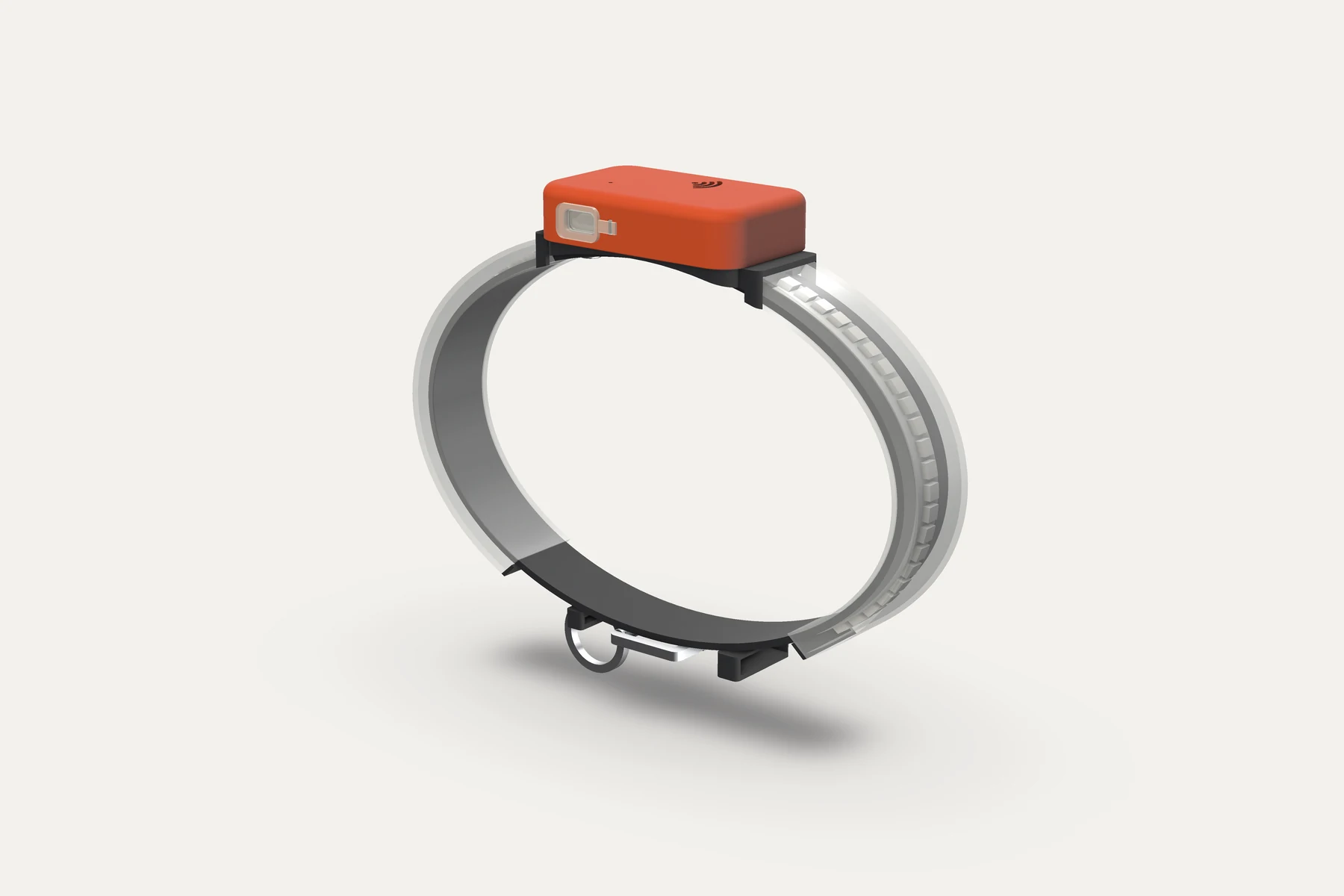
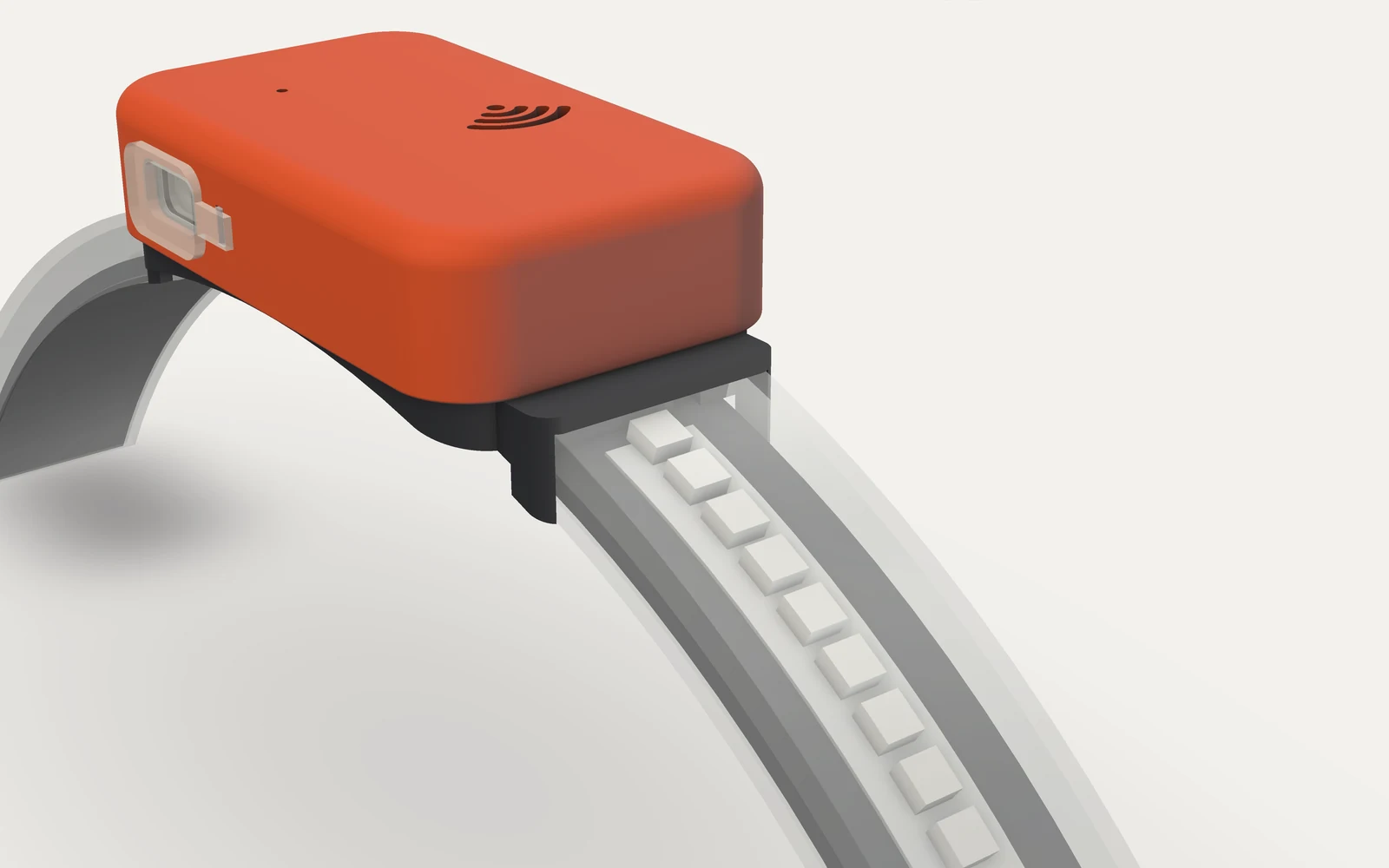
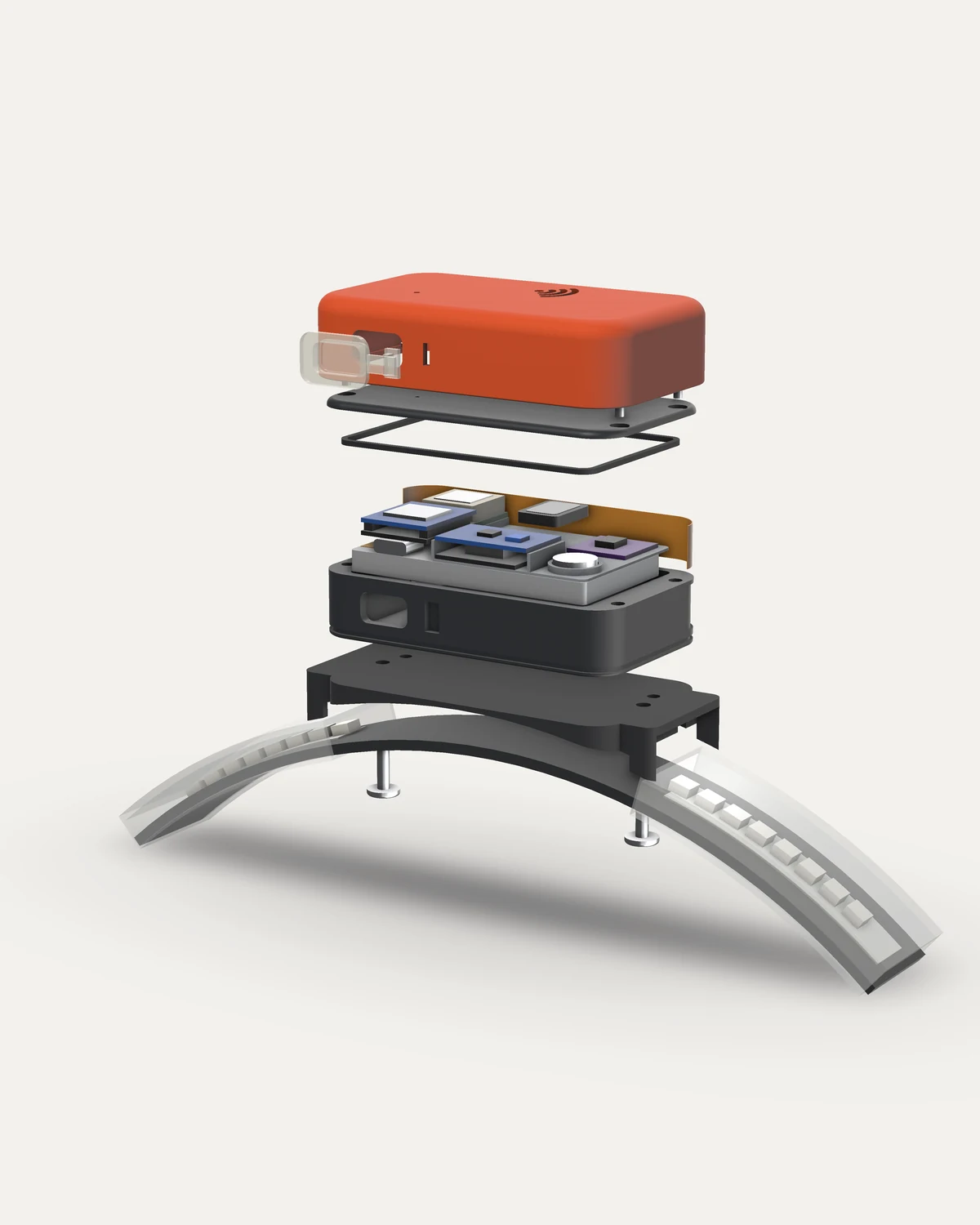
- A strip of 22 lights runs down each side of the box. Each light has red, green, blue and white. The strip is stuck to the strap and covered by a clear soft sleeve that the strap passes through.
- The sleeve is a closed tube, printed standing on its edge. Nothing clips on, so nothing can be pulled off.
- The wires never show. They leave the box through its floor at each end, run in a channel under the neck pad, and enter the sleeve inside a hood that the pad carries at each end.
- The strips run straight from the battery through a switch board. Boosting to 5 V first would draw about 60 percent more from the battery for the same light: Adafruit's 5 V booster needs 800 mA in for 500 mA out. The switch cuts the power completely, because a dark strip still draws about 44 mA.
- The processor board changes to Seeed's Sense Plus: the same size and chip, with six more usable pins on its edges. Three of them run the lights. The box, lid, bumper, carrier and plug are the collar's own.
- White points at the ground: the motion sensor feels which way is down, and the eight lights nearest to straight down show white. With the box or the buckle at the very bottom, that is four on each side.
- The lights stop short of the buckle and do not pass under the box, so about 130 mm at the buckle and 90 mm at the box are dark.
Parts to buy
| Part | What it does | Size | Cost | How sure |
|---|
| Seeed XIAO nRF52840 Sense Plus | Processor, Bluetooth, motion sensor, microphone. The same size as the collar's board, with six more usable pins on its edges; three of them run the lights | 21 x 17.8 mm | $16.40 | read on the seller's page |
| Seeed Wio-SX1262 for XIAO | LoRa radio; plugs under the processor board | stack about 22 x 23 x 8 mm (Seeed gives no drawing) | $5.09 | read on the seller's page |
| Seeed L76K GNSS module for XIAO | GPS; comes with its ceramic antenna on a 10 cm lead | 18 x 21 mm; antenna size not published | $10.90 | read on the seller's page |
| Adafruit 258 LiPo battery, 1200 mAh | Battery with protection circuit | 34 x 62 x 5 mm, 23 g | $9.95 | read on the seller's page |
| Adafruit 2130 amplifier (PAM8302) | Drives the speaker for recorded voice | 15 x 24 x 2 mm | $3.95 | read on the seller's page |
| Same Sky CMS-151125-078SP-67 speaker | Speaker, water-rated on its front face (maker: IPX7 front side) | 15 x 11 x 2.5 mm, 8 ohm, 0.7 W | $2.99 | price seen second-hand |
| Adafruit 1201 vibration motor | Vibration | 10 mm across, 2.7 mm thick | $1.95 | read on the seller's page |
| Molex 1052620001 flexible antenna | LoRa antenna, sticks into the band on the outside of the box | 79 x 10 x 0.1 mm, 100 mm lead | $4.65 | price seen second-hand |
| PCB Artists IP67 acoustic membrane | Keeps water out of the microphone hole | 8 mm disc; hole under it 3 mm or less | $1.00 | read on the seller's page; sold as 20 for $19.99 |
| Brass heat-set inserts: M2 x 3 (4), M3 x 5.7 (2) | Threads for the lid and strap screws | holes 3.2 and 4.0 mm | $0.60 | read on the seller's page; sold as 100 for about EUR 9.90 a size |
| Screws: M2 x 6 flat head (4), M3 x 12 low head (2) | Lid and strap | | $1.00 | not checked; my estimate |
| Silicone cord, 1.5 mm, 25 cm | Seal between lid and box | | $1.00 | not checked; my estimate |
| Small electronic parts | One switch transistor for the amplifier's power, one transistor and diode for the motor, resistors | | $2.00 | not checked; my estimate |
| BioThane Beta 520 strap, 1 in, 2.5 ft | The collar strap | 2.5 mm thick | $3.93 | read on the seller's page |
| Weaver #49 stainless roller buckle, 1 in | Buckle | | $4.90 | read on the seller's page |
| D-ring and strap keeper, 1 in | Leash ring | | $2.00 | not checked; my estimate |
| BTF-Lighting SK6812 RGBW light strip, 144 lights per metre, 5 V, silicone coated (IP65) | The lights: two pieces of 22 lights, one each side of the box. Each light has red, green, blue and white | 12 x 3 mm; can be cut every 6.9 mm | $6.80 | read on the seller's page; sold as 1 m for $21.24, enough for three collars; pick warm, neutral or cool white when ordering |
| Pololu 2810 power switch board | Cuts the strips' power completely when the lights are off; a dark strip would otherwise draw about 44 mA | 15 x 15 x 2.5 mm | $4.49 | read on the seller's page |
| Adafruit 2003 silicone-covered wire, 30 AWG, 2 m | Three wires to each strip | 0.8 mm across | $0.75 | read on the seller's page |
| MG Chemicals 1035 clear silicone, neutral cure | Seals the strip ends, the sleeve ends and the two wire holes | | $2.00 | not checked; my estimate; sold by the tube; price not checked |
| Total | | | $86.35 | for the amounts used in one device; packs cost more |
Options:
- Adafruit 2748 light sensor (ALS-PT19) ($2.50): Would let the collar set its own brightness. Not wired in this version: the board's spare pins cannot read it directly, so brightness follows the app, the time of day and whether the collar is at home.
Parts to print
| File (.step and .stl) | Material | Color | Grams | Size, mm | How to lay it on the bed |
|---|
light-collar-tray | PETG | slate | 16.0 | 77.6 × 44.2 × 15.2 | Open side up. No supports. |
light-collar-lid | PETG | slate | 5.5 | 77.6 × 44.2 × 1.8 | Outside face down on a textured plate. |
light-collar-carrier | PETG | grey | 1.4 | 62.2 × 38.8 × 4.8 | Flat side down. |
light-collar-bumper | TPU | blaze orange | 13.8 | 81.2 × 47.8 × 18.8 | Top face down. No supports. 95A TPU. |
light-collar-neck-pad | TPU | slate | 12.7 | 94.0 × 44.3 × 12.4 | Flat side down. The two hoods print as walls; no supports. |
light-collar-port-plug | TPU clear | clear | 0.8 | 24.5 × 5.3 × 11.6 | Cap face down. Clear or natural TPU so the charge light shows. |
light-collar-sleeve-160mm | TPU clear | clear | 16.3 | 160.0 × 28.6 × 9.7 | Print two. Stand it on one long edge, with a brim. Clear or natural TPU. Trim to length with scissors. |
light-collar-sleeve-cap | TPU | slate | 1.0 | 6.6 × 28.6 × 6.1 | Print two. Flat face down. |
| Total | | | 67.5 | | |
Inside
Wiring
| Pin on the board | Goes to |
|---|
| D0 | GPS board: standby |
| D1, D2, D3, D4, D5 | LoRa board (plugs in): signal, reset, busy, select, antenna switch |
| D6 | Amplifier's power switch transistor |
| D7 | GPS board: data in |
| D8, D9, D10 | LoRa board (plugs in): data lines |
| D11 (small pad on the board's edge) | Light data to the strip at the charging-port end, through a 330 ohm resistor |
| D12 (edge pad) | Light data to the other strip, through a 330 ohm resistor |
| D13 (edge pad) | The power switch board's ON pin. High turns the strips on. |
| D14 (edge pad; NFC1 on the other boards) | Vibration motor, through a transistor and a diode |
| D15 (edge pad; NFC2 on the other boards) | Sound out to the amplifier's A+ input, through a 1 k resistor and a 10 nF capacitor to ground; A- to ground |
| Power switch board: VIN and GND | Battery + and battery -, straight from the battery leads |
| Power switch board: VOUT | The + pad of both strips, with the 100 uF capacitor from VOUT to ground. The strips' ground pads go to battery -. |
| BAT+ and BAT- pads | Battery |
| Amplifier output | Speaker |
| On the board | Motion sensor and microphone; no wiring |
| D17, D18, D19 (edge pads) | Free |
Assembly
- Test the seal first, as for the collar, with tape over the two wire holes in the floor.
- Press the brass inserts in: four M2 into the top of the box's ends, two M3 into its underside. Stick the LoRa antenna into its band and seal its lead hole.
- Cut two pieces of light strip, 22 lights each. Scrape the coating off the three pads at the start of each piece (the end the arrows point away from). Solder three wires about 12 cm long to each: +, data, and -. Coat the joints with silicone.
- Test both strips from the board on the bench before going further.
- Punch the two strap holes, 70.4 mm apart. Stick each strip along the middle of the strap, on the outside face, starting 7 mm beyond a hole and running away from the box.
- Slide a clear sleeve over each end of the strap, over the strip, up to 6 mm from the hole. Lead the three wires out of the sleeve's open end.
- Lay the neck pad on the strap, its curved side down. Press the wires into the pad's two channels and pass them up through the pad's small holes and the box's wire holes. Screw the box to the strap through the pad with two M3 x 12 screws. Each sleeve's end now sits inside a hood on the pad.
- Fill both wire holes with silicone from inside the box. Run a bead of silicone round each sleeve where it enters its hood. Push a cap into the far end of each sleeve with silicone. Leave it a day.
- Solder the rest of the wiring in the table below. The power switch board goes beside the motor; leave its own slide switch off.
- Lay the battery in. Set the grey carrier on it. Seat the two boards upside down, charging socket in the opening. Put the GPS board between the posts with the amplifier on top, the motor in its ring, the GPS antenna on its stand, face up.
- Glue the speaker under the lid's window and the membrane over the microphone hole. Screw the lid down, pull the bumper on, fit the plug.
- To fit a smaller neck: trim the sleeves with scissors and cut the strips between two lights. A collar about 21 inches round takes the full 160 mm sleeves.
Phone radio
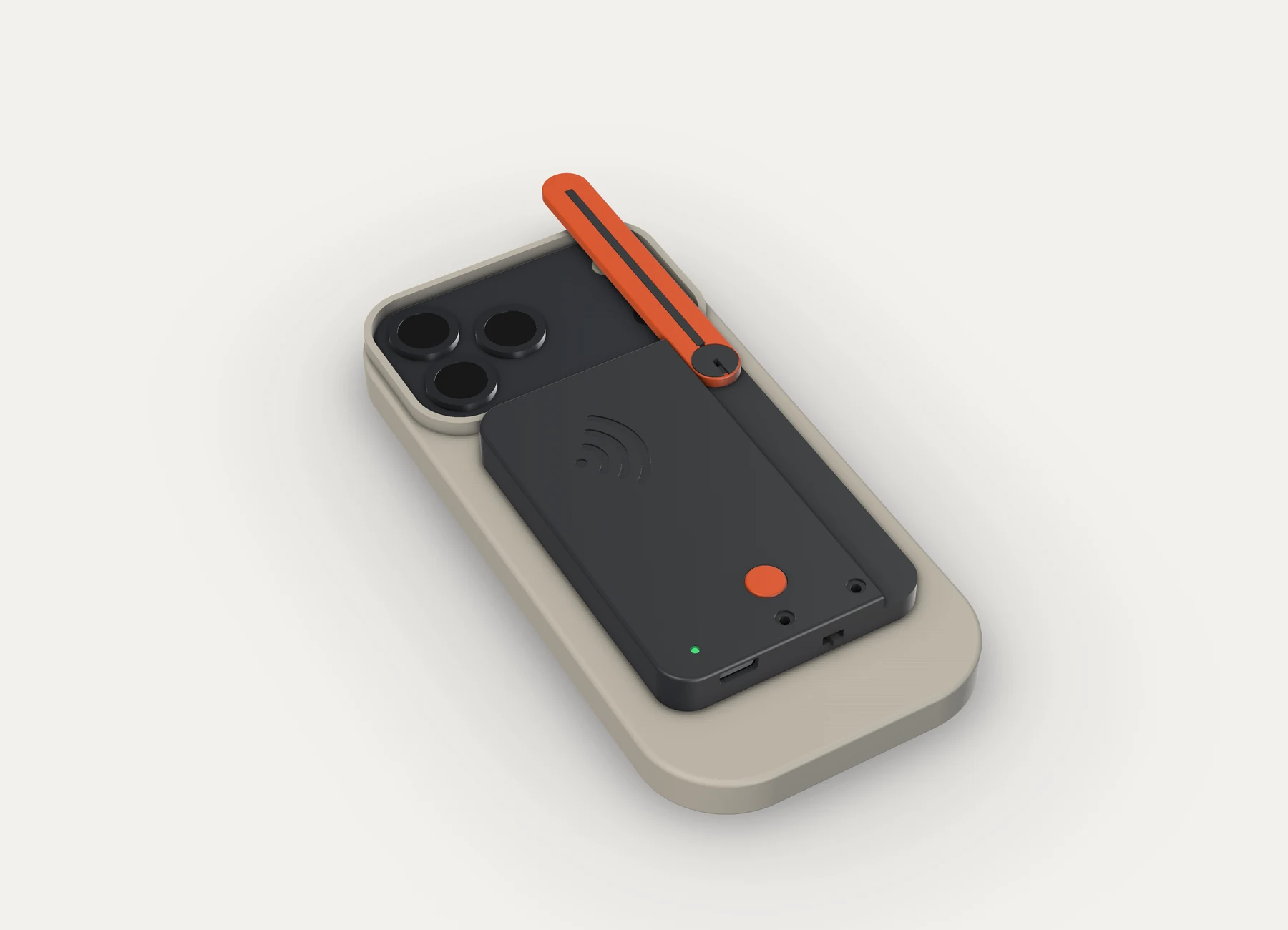
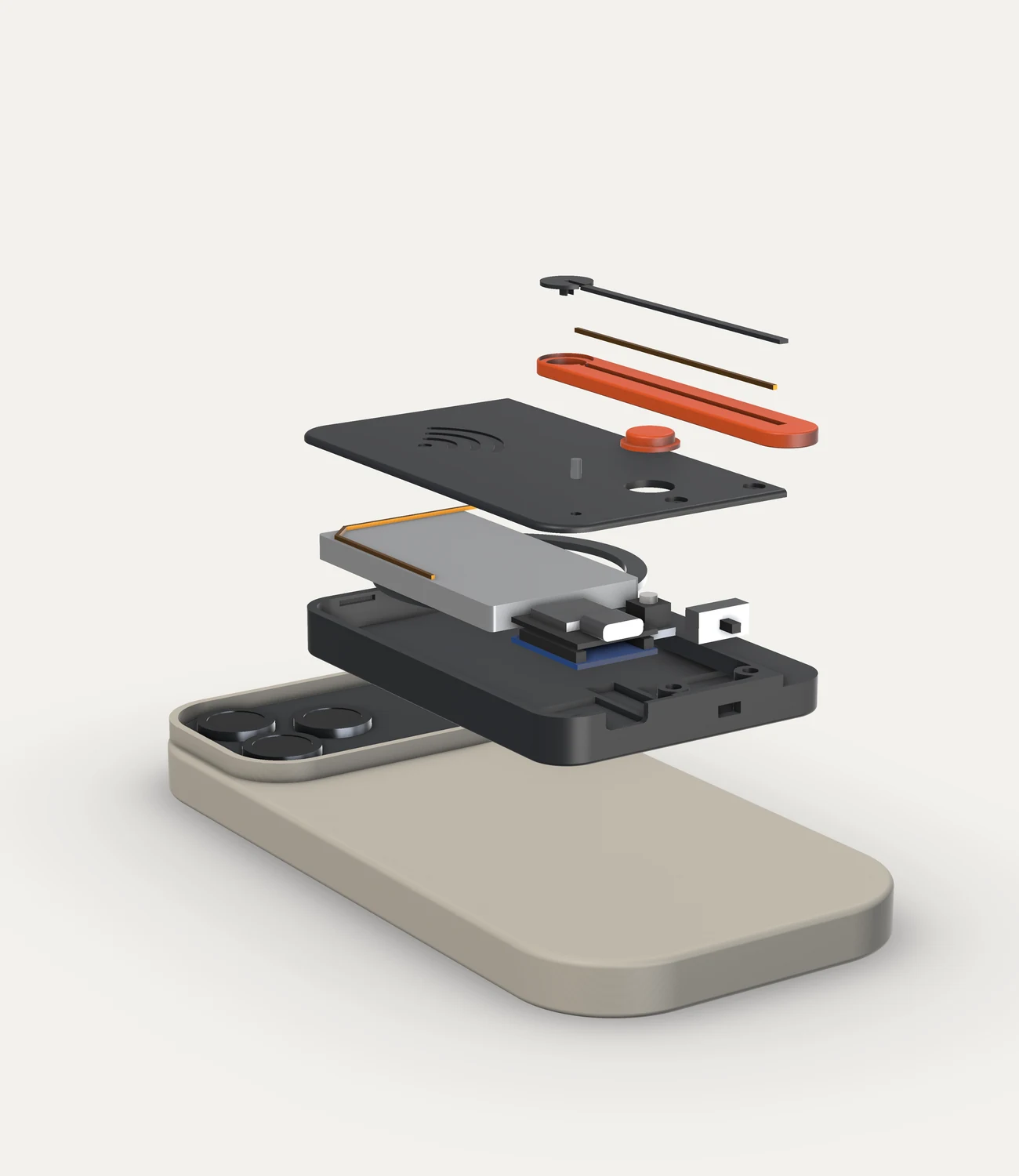
The phone radio is a slab that holds to an iPhone by magnets. Sizes come from Apple's drawing of the iPhone 18 Pro Max and Apple's accessory guidelines.
- The top edge stops 30 mm above the magnet ring's centre, which is Apple's limit toward the cameras.
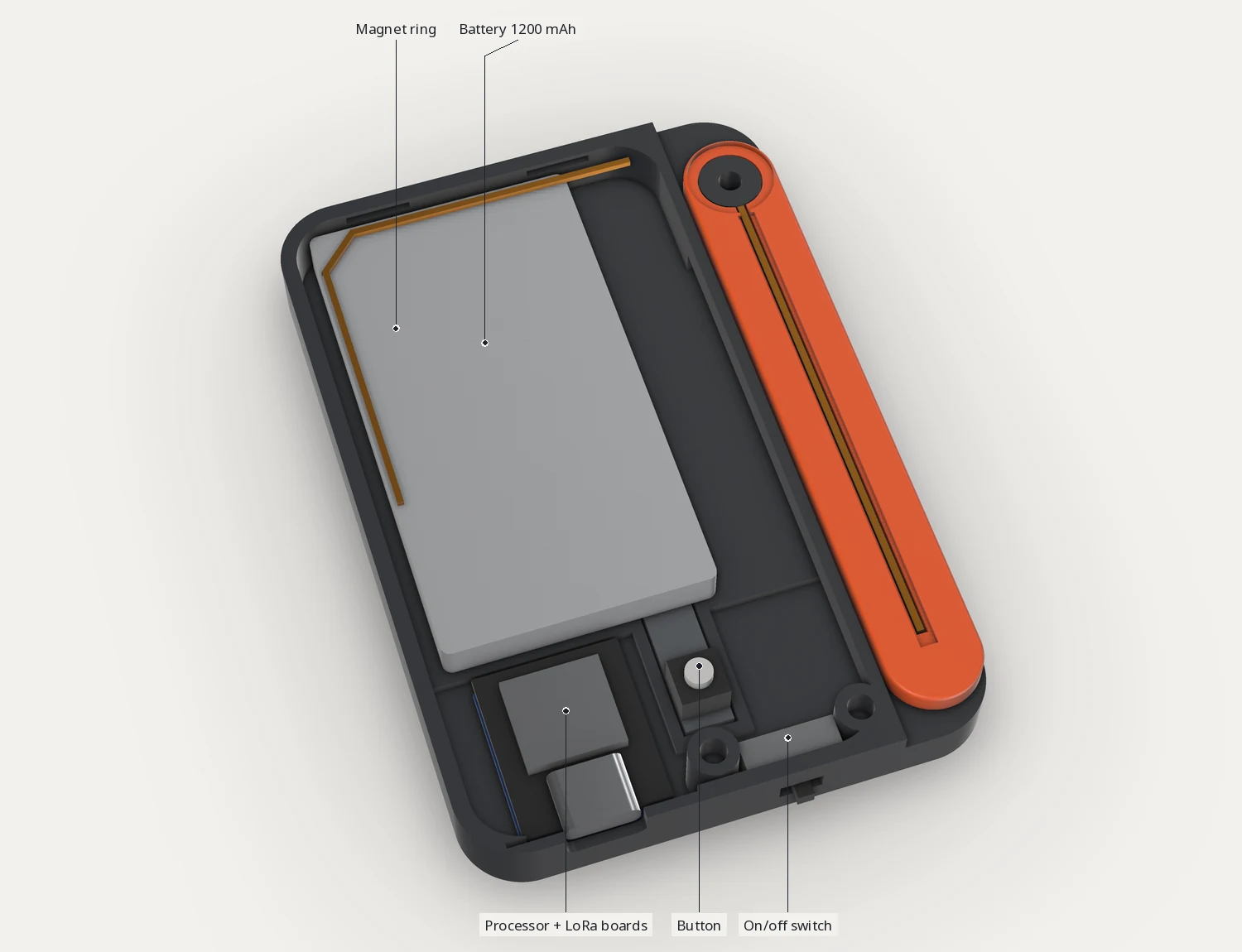
- The antenna is two 78 mm wires: one fixed inside, one in the blade. The blade turns on a hollow post and the wire runs up through the post, so it twists instead of bending.
- Folded down, the blade lies in a step along the right side. Out to the side it clears the phone's top antenna area. Straight up it stands beside the camera flash and depth sensor, so fold it aside for photos.
- The magnet ring sits under 0.85 mm of plastic, as Apple and the ring's seller both give.
Parts to buy
Parts to print
| File (.step and .stl) | Material | Color | Grams | Size, mm | How to lay it on the bed |
|---|
phone-radio-base | PETG | slate | 17.8 | 64.0 × 92.0 × 9.4 | Phone side down on a textured plate. The step bridges without supports. |
phone-radio-cover | PETG | slate | 6.5 | 51.4 × 92.0 × 3.1 | Outside face down. |
phone-radio-antenna-blade | PETG | blaze orange | 2.5 | 12.0 × 83.0 × 3.0 | Flat, groove up. |
phone-radio-blade-strip | PETG | slate | 0.1 | 2.0 × 63.6 × 0.8 | Flat. Glued over the antenna wire. |
phone-radio-pivot-cap | PETG | slate | 0.1 | 10.8 × 10.8 × 2.8 | Disc down. |
phone-radio-button | PETG | blaze orange | 0.2 | 11.0 × 11.0 × 2.8 | Flange down. |
phone-radio-light-pipe | PETG clear | clear | 0.0 | 1.9 × 1.9 × 3.4 | Or a 10 mm piece of clear 1.75 mm filament. |
| Total | | | 27.2 | | |
Inside
Wiring
| Pin on the board | Goes to |
|---|
| D1 to D5, D8 to D10 | LoRa board (plugs in) |
| D0 | Push button, other side to ground |
| BAT+ pad | Battery red lead, through the slide switch |
| BAT- pad | Battery black lead |
| LoRa board's antenna socket | U.FL lead: centre wire to the 78 mm wire in the blade, braid to the 78 mm wire fixed inside |
Assembly
- Press two M2 inserts into the cover posts in the base.
- Try the magnet ring on the phone before gluing: the face that grips the phone goes down. Glue the ring into its pocket, steel side up, with its gap toward the bottom. Glue the straight magnet into its slot. Check that the base snaps on and sits straight.
- Pass the U.FL lead's bare end up through the hollow post. Solder its centre wire to a 78 mm copper wire, lay the wire in the blade's groove, and glue the slate strip over it. Solder a second 78 mm wire to the lead's braid and run it along the top and left walls.
- Slide the blade over the post. Glue the cap to the post only, so the blade still turns.
- Put the battery over the magnets and the boards at the bottom with the charging socket in its notch. Fit the slide switch in its slot and the button on its pad. Solder the wiring in the table below.
- Push the clear light pipe into the cover. Hook the cover under the top edge and fix it with two M2 screws.
Car monitor
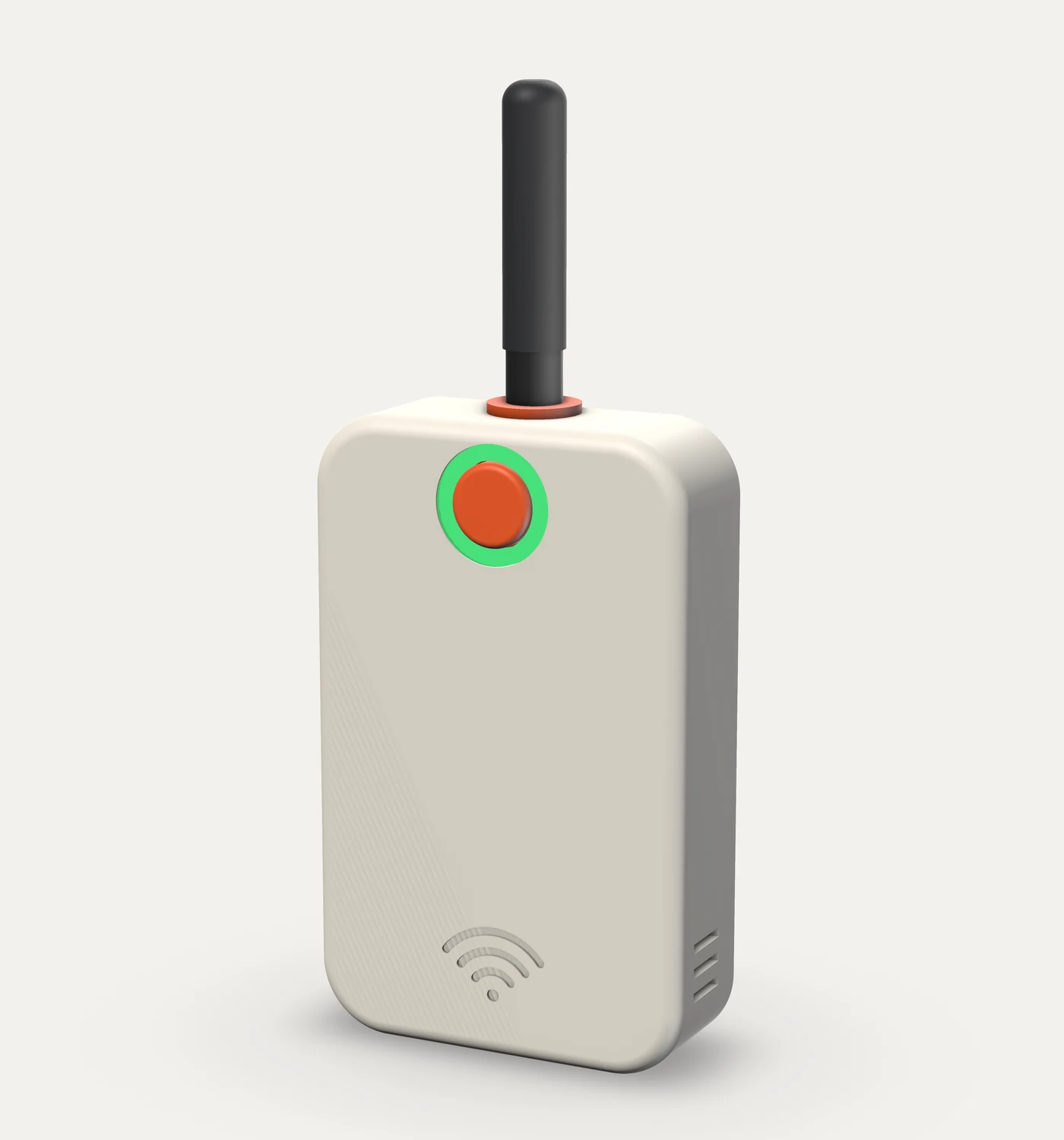
The car monitor measures cabin heat and humidity, sends alarms over LoRa, relays the collar, and has a socket for a bigger antenna.
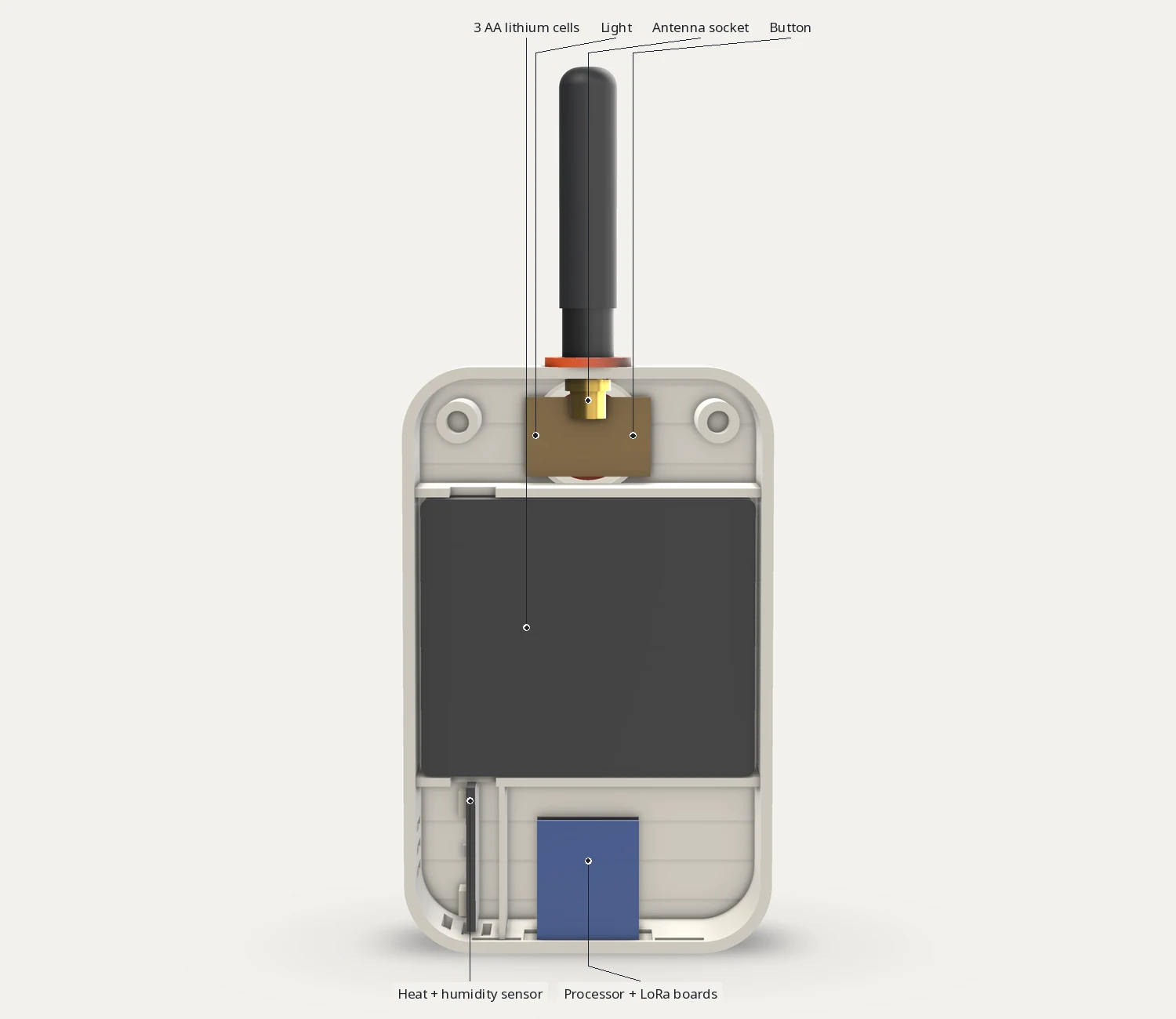
- It runs from the car's USB socket and falls back to three AA lithium cells. There is no rechargeable battery: charging one above 45 C is unsafe, and the board's charger cannot sense temperature.
- The sensor board stands on edge in its own channel at one side, walled off from the boards and the cells. Its vents are in the side and the bottom, not the front, so the sun does not shine in. The mark on the front is a shallow logo.
- The charging socket is at the bottom centre, so the cable hangs straight down.
- The shell is light colored so the sun warms it less. Print it in ASA, which keeps its shape in a hot car.
- The short antenna unscrews. A magnetic roof antenna on a 3 m lead screws on in its place.
Parts to buy
Options:
Parts to print
| File (.step and .stl) | Material | Color | Grams | Size, mm | How to lay it on the bed |
|---|
car-monitor-body | ASA | bone white | 23.5 | 64.0 × 102.0 × 21.0 | Front face down on a textured plate. Light colour so the sun does not heat it. |
car-monitor-back-cover | ASA | bone white | 13.1 | 64.0 × 102.0 × 11.4 | Inside face down. The strap bridge prints as a bridge, no supports. |
car-monitor-button | ASA | blaze orange | 0.6 | 16.0 × 16.0 × 4.6 | Flange down. |
car-monitor-light-ring | PETG clear | clear | 0.5 | 20.7 × 20.7 × 2.8 | Flange down. |
car-monitor-antenna-ring | ASA | blaze orange | 0.2 | 15.0 × 15.0 × 1.6 | Flat. |
| Total | | | 37.9 | | |
Inside
Wiring
| Pin on the board | Goes to |
|---|
| D1 to D5, D8 to D10 | LoRa board (plugs in) |
| D0 | Push button, other side to ground |
| D6 and D7 | Sensor board: data (SDA) and clock (SCL) |
| 3V3 and GND | Sensor board power |
| NFC1 and NFC2 pads | Two-colour light with one 330 ohm resistor between them: one way round is green, the other red |
| 5V pin | Battery holder's red lead, through the 1N5817 diode with its stripe toward the board. The diode is required. |
| GND | Battery holder's black lead |
| LoRa board's antenna socket | Lead to the antenna socket in the top |
Assembly
- Press two M3 inserts into the posts at the top of the body.
- Push the antenna socket up through the hole in the top with the orange ring under its nut. Clip its lead to the LoRa board.
- Slide the sensor board on edge into the channel at the bottom right (seen from the front), sensor toward the side vents.
- Put the clear ring and the orange button in from behind. Mount the button switch and the two-colour light on a scrap of board behind them.
- Set the battery holder between the two shelves. Solder the diode into its red lead, stripe toward the board.
- Seat the boards at the bottom with the charging socket in its notch. Solder the wiring in the table below.
- Hook the back cover in at the bottom and fix it with two M3 screws. Thread the strap through the bridge.
- Fit three AA lithium cells (Energizer Ultimate Lithium or the same type). Do not fit rechargeable cells.
Home base
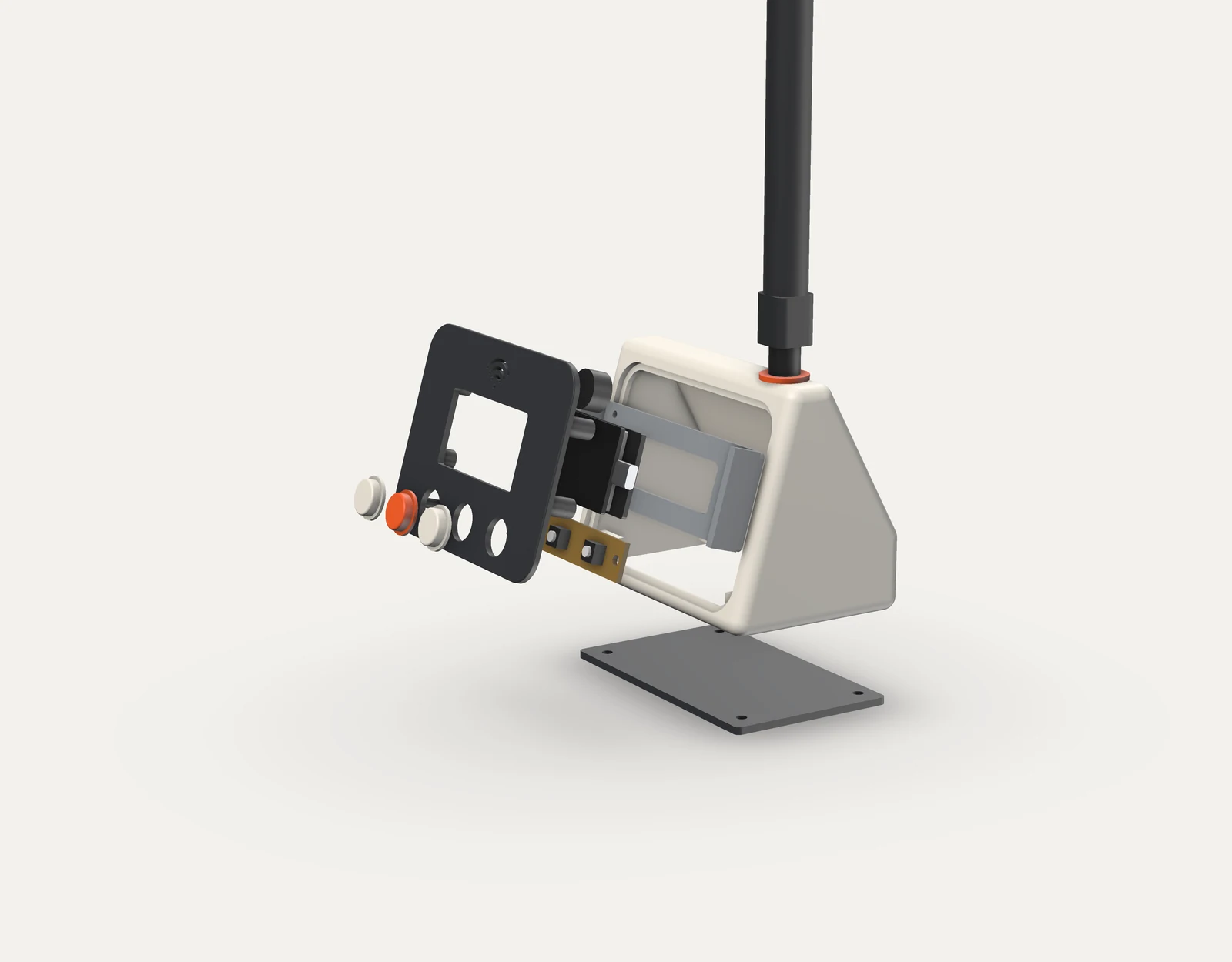
The home base is a desk unit with a 1.9 inch color screen, three buttons, a buzzer, Wi-Fi and a tall LoRa antenna.
- The board changed from the earlier plan: a Heltec Vision Master T190 instead of the Heltec WiFi LoRa 32 V3. Same processor family and radio chip, a much larger screen, about the same price.
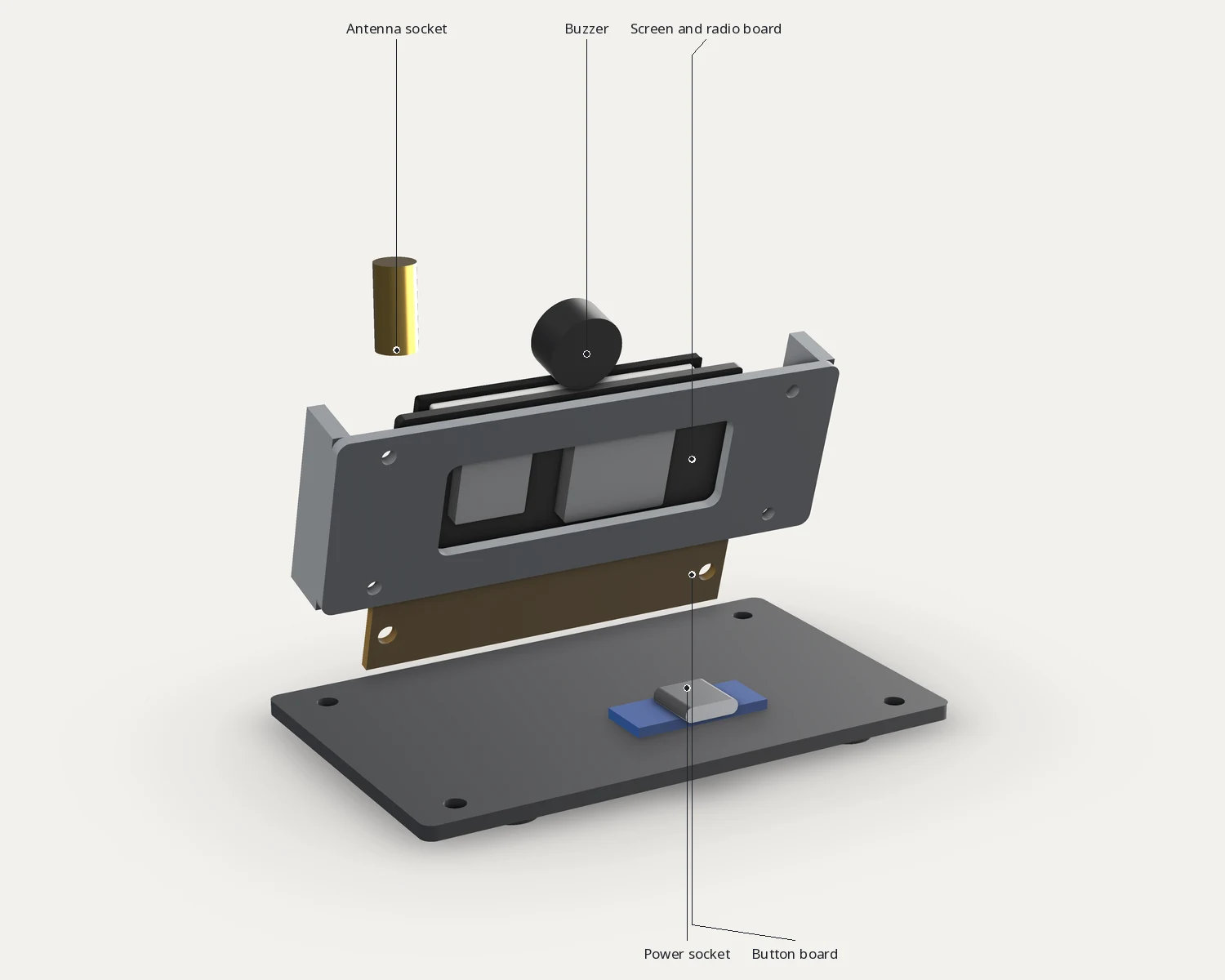
- The dark front panel is a separate print that drops into a recess. A clamp behind the screen board pulls the panel against its ledge, so no screws show.
- Power comes in through a USB-C socket on the back, wired to the board's 5 V pin.
- It holds the key that reads reports, not the key that sends commands.
Parts to buy
| Part | What it does | Size | Cost | How sure |
|---|
| Heltec Vision Master T190, 902-928 MHz | Processor, Wi-Fi, LoRa radio and a 1.9 inch colour screen | 60 x 25.4 x 10.2 mm; screen 22.7 x 42.7 mm | $19.00 | read on the seller's page |
| Adafruit 851 SMA-to-U.FL lead | Antenna socket on the case | 150 mm lead, 11 mm thread | $3.95 | read on the seller's page |
| ALFA ARS-915P antenna | Antenna, 2 dBi, folds at an elbow | 195 x 13.3 mm | $11.97 | read on the seller's page |
| Adafruit 160 piezo buzzer | Alert sound | 12 mm across, 6.5 mm tall | $1.50 | read on the seller's page |
| Push button switches 6 x 6 x 5 mm (3) | Three buttons | | $0.38 | read on the seller's page; from the same pack of 20 |
| USB-C socket board (Adafruit 4090) | Power socket on the back | size not checked | $2.95 | not checked; my estimate |
| Strip of prototyping board, wire, 4 stick-on rubber feet | Carries the buttons | | $2.00 | not checked; my estimate |
| Brass heat-set inserts M2 x 3 (4), M3 x 5.7 (4); screws M2 x 6 (4), M3 x 8 (4) | Screen clamp and base plate | | $1.20 | read on the seller's page |
| Total | | | $42.95 | for the amounts used in one device; packs cost more |
Parts to print
| File (.step and .stl) | Material | Color | Grams | Size, mm | How to lay it on the bed |
|---|
home-base-shell | PETG | bone white | 40.1 | 96.0 × 60.5 × 72.5 | Standing as it sits on the desk. No supports. |
home-base-front-panel | PETG | slate | 9.3 | 84.0 × 64.0 × 12.6 | Outside face down on a textured plate. |
home-base-screen-clamp | PETG | grey | 5.2 | 86.8 × 30.0 × 11.1 | Flat side down, legs up. |
home-base-button | PETG | one blaze orange, two bone white | 0.4 | 13.2 × 13.2 × 3.9 | Print three. Flange down. |
home-base-base-plate | PETG | slate | 12.1 | 90.7 × 55.5 × 2.4 | Flat. |
home-base-antenna-ring | PETG | blaze orange | 0.2 | 15.0 × 15.0 × 1.6 | Flat. |
| Total | | | 67.3 | | |
Inside
Wiring
| Pin on the board | Goes to |
|---|
| GPIO1, GPIO2, GPIO4 | Left, middle and right buttons, other side to ground |
| GPIO44 | Buzzer, other leg to ground |
| 5V and GND pins | USB-C socket board on the back: 5 V and ground |
| LoRa antenna socket (back of the board) | Lead to the antenna socket in the top |
| On the board | Screen, Wi-Fi, LoRa radio; no wiring |
Assembly
- Press four M2 inserts into the posts on the back of the front panel and four M3 inserts into the blocks inside the shell.
- Load the board's program through its own USB-C socket before closing up.
- Press the buzzer into its ring. Solder three button switches to a strip of board, set it on its two pegs, and drop the three button caps into their holes.
- Lay the screen board face down in the panel's window. Offer the panel into the front of the shell, hold the grey clamp behind it from inside, and fix the clamp to the panel's posts with four M2 screws. The clamp's legs pull the panel against its ledge.
- Push the antenna socket up through the top with the orange ring under its nut. Clip its lead to the LoRa socket on the back of the board.
- Glue the USB-C socket board on its shelf at the back. Solder the wiring in the table below.
- Screw the base plate on with four M3 screws and stick on the feet. Screw on the antenna.
Custom board
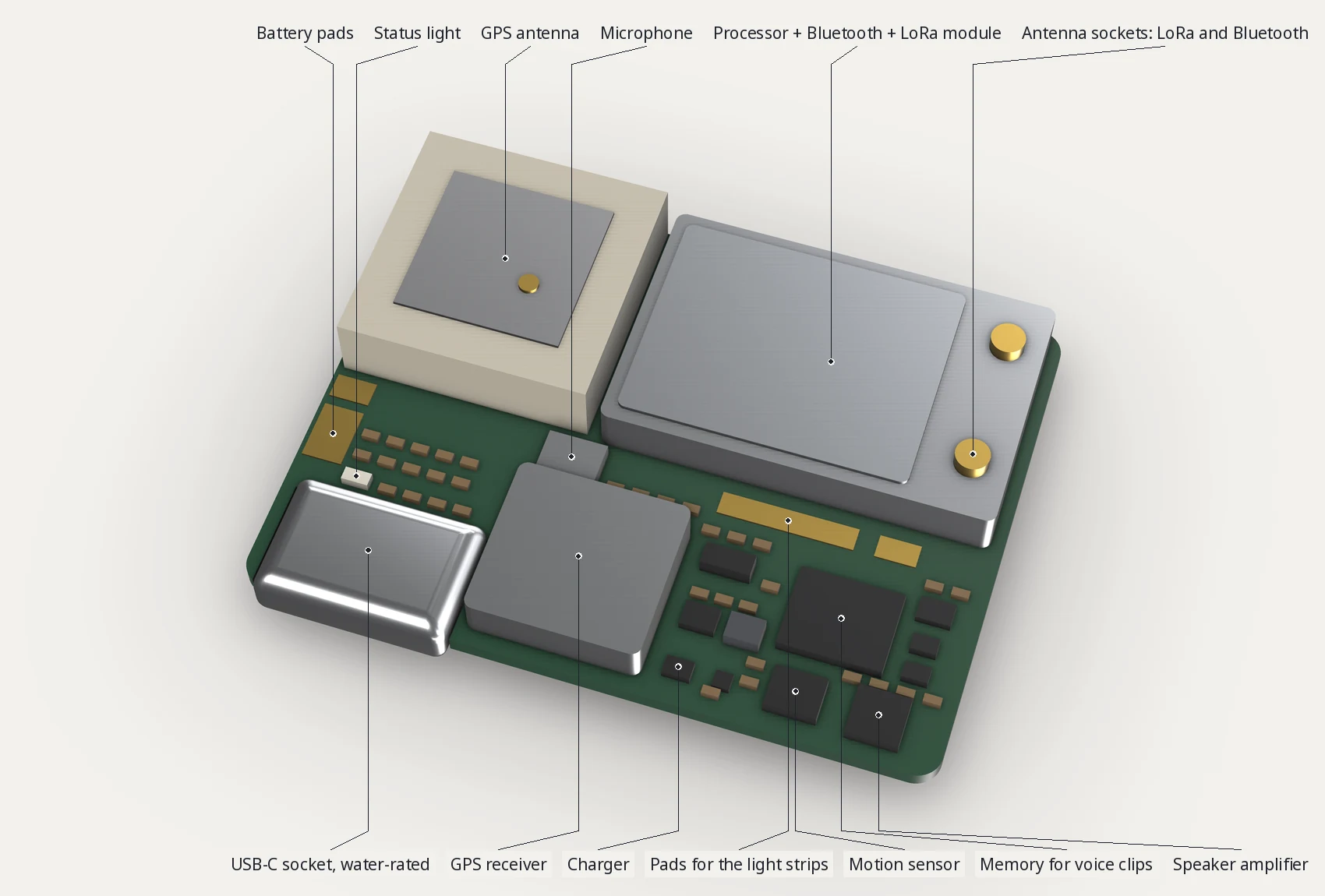
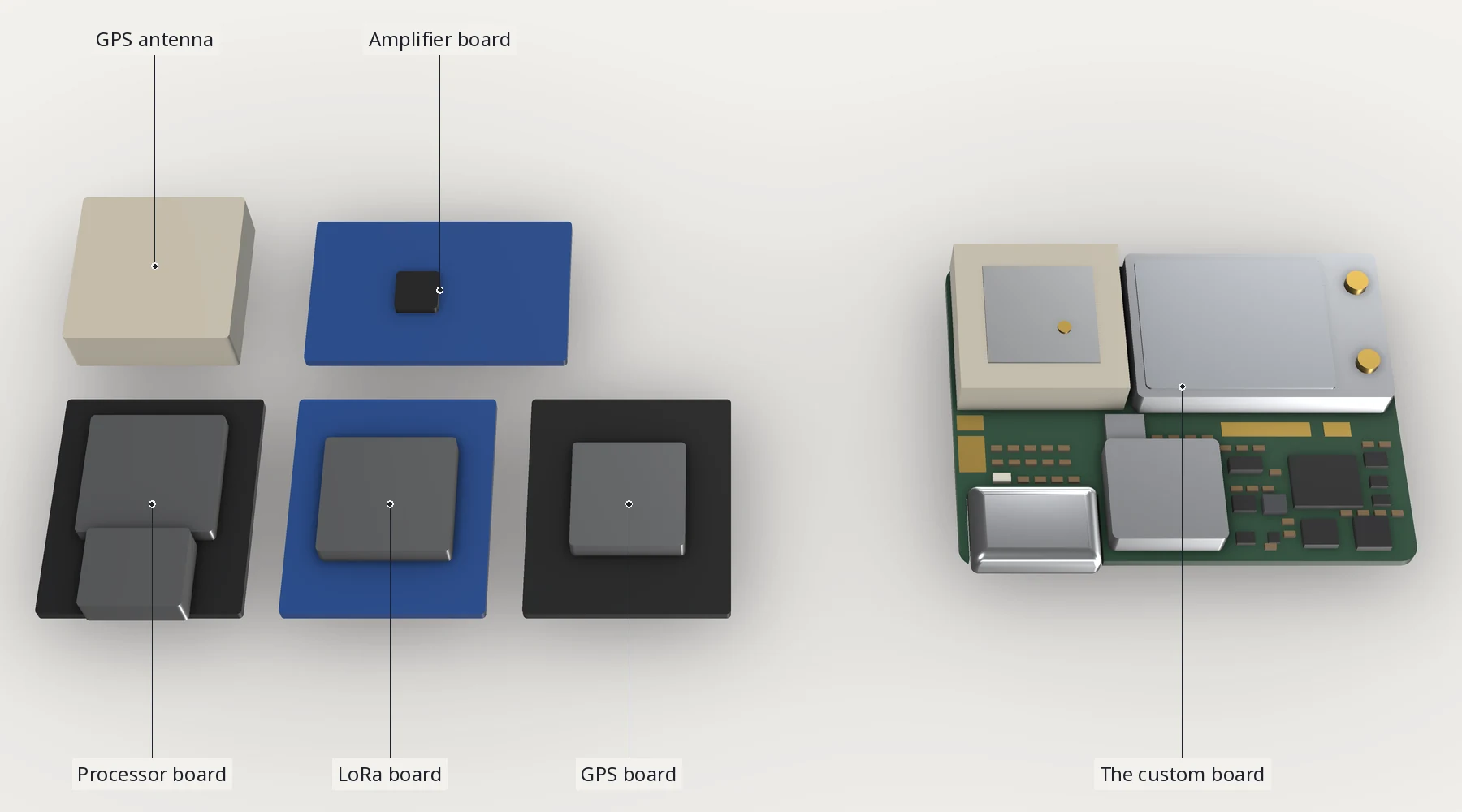
What this is: one board, 40 x 30 mm, that replaces the four store-bought boards in a collar. The parts are chosen, the connections are listed, and the outline and the place of every part are drawn and fitted into two collars.
What it is not yet: a board a maker can build. The copper tracks (the layout) have not been drawn. That needs a board design program, such as KiCad, which is free, or a layout service.
What it changes
- Battery: the collar's box keeps its footprint and holds 2000 mAh in place of 1200. The small collar gets shorter and thinner and holds 500 mAh in place of 350.
- Tracking: the GPS receiver draws 12 mA where the store-bought GPS board draws 41. Plan on about 3 days of tracking every 2 seconds in place of about 18 hours.
- At home: the microphone waits for a loud sound on 0.02 mA, and the GPS receiver's power is switched off. Plan on about 3 months in place of about 13 days.
- Charging: about 5 hours in place of about 13 hours, and the charger slows or stops when the battery is hot or cold.
- Water: the USB-C socket is water-rated by itself, so the clear plug becomes a second seal.
- Cost: more, in small numbers. The parts on the board come to about $61; the four store-bought boards it replaces cost $35.84. Assembly is on top.
| Collar | Battery | Tracking | Walk | At home | Charge |
|---|
| Collar, store-bought boards | 1200 mAh | about 18 hours | about 3 days | about 13 days | about 13 hours |
| Collar on the custom board | 2000 mAh | about 3 days | about 17 days | about 3 months | about 5 hours |
| Small collar, store-bought boards | 350 mAh | about 5 hours | about 19 hours | about 4 days | about 4 hours |
| Small collar on the custom board | 500 mAh | about 19 hours | about 4 days | about 4 weeks | about 2 hours |
These are the "plan on" figures from the battery sums, worked out the same way. The radio figures are the store-bought LoRa board's, because the module's maker publishes no receive current.
Parts on the board
| Part | What it does | Size | Cost | How sure |
|---|
| RAKwireless RAK4630 module, with antenna sockets | Processor, Bluetooth and LoRa radio in one part, already approved by the FCC | 15 x 23 x 3 mm | $15.00 | read on the seller's page |
| u-blox MAX-M10S GPS receiver | GPS. Draws 12 mA tracking, where the store-bought GPS board draws 41 | 10.1 x 9.7 x 2.5 mm | $12.72 | price seen second-hand |
| Taoglas DSGP.1575.15.4.A.02 GPS antenna | GPS antenna, soldered to the board | 15 x 15 x 4 mm; its maker asks for 50 x 50 mm of copper under it | $7.46 | price seen second-hand |
| TDK T5838 microphone | Waits for a loud sound on 0.02 mA, then wakes the processor | 3.5 x 2.65 x 0.98 mm; runs on 1.8 V; no water rating, so it sits behind the membrane | $2.32 | price seen second-hand |
| ST LSM6DSV16X motion sensor | Counts steps and sorts activity inside the sensor, so the processor can sleep | 2.5 x 3.0 x 0.83 mm | $2.89 | price seen second-hand |
| Analog Devices MAX98357A amplifier | Drives the speaker from digital sound; 0.77 W into 8 ohms on a 3.7 V battery | 3 x 3 x 0.75 mm | $1.26 | price seen second-hand |
| TI BQ25180 charger | Charges at up to 1 A and slows or stops when the battery is hot or cold | 1.6 x 1.1 mm | $2.28 | read on the seller's page |
| TI TPS62840 3.3 V supply | Feeds the board; idles on 60 nA | 1.5 x 2.0 mm, plus one small coil | $1.72 | read on the seller's page |
| TI TPS7A02 1.8 V supply | Feeds the microphone | 1.0 x 1.0 mm | $1.01 | read on the seller's page |
| Voltage translator chip, 3 lines (not chosen yet) | Lets the 1.8 V microphone talk to the 3.3 V processor | about 2 x 1.4 mm | $0.80 | not checked; my estimate |
| Winbond W25Q32JV memory, 4 MB | Holds the recorded voice clips: about two minutes | 6 x 5 x 0.75 mm | $1.37 | price seen second-hand |
| GCT USB4720-03-A USB-C socket | Charging and loading programs. Water-rated (IP67) when the case presses on its gasket | 11.3 x 7.6 x 3.75 mm; sits in a notch in the board's edge | $2.43 | price seen second-hand |
| Small parts | Two switch chips (GPS power, light power), motor transistor and diode, status light, temperature sensor for the battery, a coil, about 45 resistors and capacitors | | $4.00 | not checked; my estimate |
| The bare board, four layers | OSH Park's price: three boards of this size for $18.60 | 40 x 30 x 1.0 mm | $6.20 | read on the seller's page; sold as three for $18.60 |
| Total | | | $61.46 | for the amounts used in one device; packs cost more |
Who can make it
| Maker | Where | What it does | How long |
|---|
| MacroFab | Houston, Texas | Makes the board and solders the parts on. No minimum order. Takes KiCad design files as they are. Buys the parts, or uses parts you send. | as little as 10 days |
| CircuitHub | Massachusetts | Board and assembly from one board up, four layers, parts on both sides. Takes KiCad files. | 3 days for its prototype service |
| Screaming Circuits | Oregon | Board and assembly from one board up. Buys the parts or uses yours. | 1 to 10 days once it has the parts |
| JLCPCB | China | Board and assembly from two boards up. Parts on both sides needs its Standard service. It stocks the radio module this board uses. | 4 days or more, plus shipping |
| PCBWay | China | Board and assembly from five boards up. Also offers to draw the board. | 3 to 5 days, plus shipping |
| Seeed Fusion | Shenzhen, China | Board and assembly from one board up. Seeed also offers to design a whole product round its own modules, but then Seeed owns the design unless agreed otherwise. | from 7 working days, plus shipping |
| OSH Park | United States | Bare boards only: three four-layer boards of this size for about $18.60. Someone still has to solder the parts on. | 9 to 14 days |
- Import duty. Boards assembled in China now carry US duty. JLCPCB and PCBWay collect it up front: PCBWay estimates 47.5 percent on assembled boards, and JLCPCB quotes 35 percent or more. The $800 duty-free allowance is suspended. Source.
- Drawing the board. Before any maker can start, someone has to draw the copper (the layout) from the parts and connections listed here. JLCPCB's layout service charges $0.46 a pin with assembly, $100 at least. PCBWay and Seeed also offer it, with no prices published. KiCad, the free design program, is what MacroFab, CircuitHub and OSH Park take files from. Source.
- Radio approval. The radio module is already approved by the FCC (ID 2AF6B-RAK4630), but only with the antennas it was tested with (up to 3 dBi, on a connector), kept 20 cm from people, and with no second transmitter beside it. A collar is handled by people, so a product for sale needs that approval extended, and the finished collar needs its own emissions test either way. All of this is work for before a sale. Source.
- What a first run might cost. My rough estimate for five assembled boards from JLCPCB, built from its published fee table and not a quote: parts about $275, boards about $30, assembly fees about $115, duty about $170, shipping about $30. About $620, or $125 a board. No US maker publishes a price; each gives a quote from the design files.
- My recommendation. Get the layout drawn first. Then ask MacroFab (Houston) and JLCPCB for quotes on five boards from the same files, and choose on price and time.
Connections
The module has 25 usable pins, by my count of its data sheet. This list uses 24, or all 25 with the optional GPS time pulse. On this processor nearly any job can use any pin, so the person drawing the layout picks the pins that route best.
| Group | Signal | From | To | Note |
|---|
| Power | USB 5 V | USB-C socket VBUS | Charger input | Two 5.1 k resistors from the socket's CC pins to ground, so any charger turns on. Protection diodes on the socket's pins. |
| Power | Battery | Charger battery pin | Battery pads | A temperature sensor (10 k NTC) beside the battery goes to the charger, so it stops charging when the battery is hot or cold. |
| Power | System | Charger output | 3.3 V regulator input; amplifier; motor; light switch | The battery's own voltage, 3.3 to 4.2 V. |
| Power | 3.3 V | Regulator output | Module, motion sensor, microphone, memory, GPS switch | |
| Power | Battery level | Battery, through two large resistors (10 M each) | Module, an analog pin | 1 pin. The resistors draw 0.2 uA, so they need no switch. |
| Power | Charger signal | Charger's interrupt pin | Module, any pin | 1 pin. Tells the processor a charger was plugged in, which starts the two-minute pairing window. |
| Module | USB data | USB-C socket D+ and D- | Module USB pins | For loading programs. |
| Module | Programming pads | Module SWDIO, SWCLK, reset | Three pads plus 3.3 V and ground | For the first program and for rescue. |
| Module | LoRa antenna | Module's LoRa socket | The antenna chosen by the antenna test | On a lead. The module's approval does not allow an antenna drawn on this board. |
| Module | Bluetooth antenna | Module's Bluetooth socket | A small stick-on antenna inside the box | |
| GPS | Power | 3.3 V, through a switch chip | GPS receiver | 1 pin turns the switch on. The receiver's memory pin stays fed, so it restarts in about a second. |
| GPS | Data | GPS receiver TX and RX | Module, any two pins | 2 pins. Serial, 9,600 bits a second to start. |
| GPS | Time pulse (optional) | GPS receiver 1PPS | Module, any pin | 1 pin, the last free one. Exact time, only needed if collars are ever to relay for each other in timed slots. |
| GPS | Antenna | GPS antenna's pin | GPS receiver's antenna input | A short 50 ohm trace. The antenna needs unbroken copper under it. |
| Sensors | Motion sensor and charger | Their data and clock lines (I2C) | Module, any two pins | 2 pins, shared by the motion sensor and the charger. |
| Sensors | Motion wake | Sensor INT1 | Module, any pin | 1 pin. Wakes the processor on movement. |
| Sensors | Microphone sound | Microphone clock and data, through the voltage translator | Module, any two pins | 2 pins. The microphone runs on 1.8 V. |
| Sensors | Microphone wake | Microphone's wake output, through the voltage translator | Module, any pin | 1 pin. The microphone wakes the processor when it hears something loud. |
| Sound | Amplifier sound | Module, three pins (digital sound) | Amplifier | 3 pins. |
| Sound | Amplifier on | Module, any pin | Amplifier shutdown pin | 1 pin. |
| Sound | Speaker | Amplifier outputs | Two speaker pads | |
| Memory | Voice clips | Memory chip, four lines | Module, any four pins | 4 pins. |
| Motor | Vibration | Module, any pin | Transistor, then the motor pads | 1 pin. A diode across the motor pads. |
| Lights | Power | Battery voltage, through a switch chip | Light pads, + | 1 pin turns the switch on. |
| Lights | Data | Module, any two pins, each through 330 ohms | Light pads, data 1 and data 2 | 2 pins. Only used by the light collar. |
| Light | Status | Module, any pin | Status light behind the socket | 1 pin. Shows through the clear plug. |
Not checked, for the board
- The layout is not drawn, so nothing proves that every track fits on four layers with all the parts on one side.
- The GPS antenna's maker asks for 50 x 50 mm of copper under it. This board is 40 x 30 mm, so expect less than the data sheet's gain. It needs a test, and perhaps the 18 mm antenna.
- The microphone has no water rating and runs on 1.8 V. It sits behind the membrane, and the chip that translates its signals to 3.3 V is not chosen.
- The FCC approved the radio module at 0.038 W, well under the 0.16 W its data sheet offers. A product for sale has to stay inside the approval or be approved again.
- The charging socket is water-rated only when the case squeezes its gasket by 0.1 to 0.2 mm. A printed case may not hold that, which is why the plug stays.
- Prices marked second-hand were seen in search results, not on the seller's own page.
Collar on the custom board
The collar rebuilt on the custom board: the same footprint, a 2000 mAh battery in place of 1200.
- The board lies on a frame over the battery. The speaker and the motor sit beside the board.
- The box is 1.7 mm thicker than the collar's. The battery's shop page says 7 mm thick; its data sheet allows 8.5 mm, and the box is sized for the data sheet.
- The charging socket is sunk into a notch in the board's edge, so its middle is level with the middle of the board. That keeps the opening below the lid.
- The LoRa antenna is still the stick-on strip in the band round the box, until the antenna test picks a winner.
Parts to buy
| Part | What it does | Size | Cost | How sure |
|---|
| The custom board, with its parts | Everything electronic except the battery, speaker, motor and antennas. Parts only: assembly is extra | 40 x 30 mm, 5.6 mm tall with its parts | $61.46 | not checked; my estimate |
| Adafruit 2011 LiPo battery, 2000 mAh | Battery with protection circuit | shop page: 60 x 36 x 7 mm, 34 g; its data sheet allows up to 62 x 38.5 x 8.5 mm, and the box is sized for that | $12.50 | read on the seller's page |
| Same Sky CMS-151125-078SP-67 speaker | Speaker, water-rated on its front face (maker: IPX7 front side) | 15 x 11 x 2.5 mm, 8 ohm, 0.7 W | $2.99 | price seen second-hand |
| Adafruit 1201 vibration motor | Vibration | 10 mm across, 2.7 mm thick | $1.95 | read on the seller's page |
| PCB Artists IP67 acoustic membrane | Keeps water out of the microphone hole | 8 mm disc; hole under it 3 mm or less | $1.00 | read on the seller's page; sold as 20 for $19.99 |
| Brass heat-set inserts: M2 x 3 (4), M3 x 5.7 (2) | Threads for the lid and strap screws | holes 3.2 and 4.0 mm | $0.60 | read on the seller's page; sold as 100 for about EUR 9.90 a size |
| Screws: M2 x 6 flat head (4), M3 x 12 low head (2) | Lid and strap | | $1.00 | not checked; my estimate |
| Silicone cord, 1.5 mm, 25 cm | Seal between lid and box | | $1.00 | not checked; my estimate |
| BioThane Beta 520 strap, 1 in, 2.5 ft | The collar strap | 2.5 mm thick | $3.93 | read on the seller's page |
| Weaver #49 stainless roller buckle, 1 in | Buckle | | $4.90 | read on the seller's page |
| D-ring and strap keeper, 1 in | Leash ring | | $2.00 | not checked; my estimate |
| Bluetooth antenna, stick-on, with a U.FL lead | Bluetooth for setup and close range; the module has a socket for it | about 25 x 6 mm | $2.00 | not checked; my estimate |
| Molex 1052620001 flexible antenna | LoRa antenna, sticks into the band on the outside of the box | 79 x 10 x 0.1 mm, 100 mm lead | $4.65 | price seen second-hand |
| Total | | | $99.98 | for the amounts used in one device; packs cost more |
Parts to print
| File (.step and .stl) | Material | Color | Grams | Size, mm | How to lay it on the bed |
|---|
board-collar-tray | PETG | slate | 17.7 | 77.6 × 44.2 × 16.9 | Open side up. No supports. |
board-collar-lid | PETG | slate | 5.5 | 77.6 × 44.2 × 1.8 | Outside face down on a textured plate. |
board-collar-carrier | PETG | grey | 0.7 | 61.7 × 37.4 × 2.1 | Flat side down. |
board-collar-bumper | TPU | blaze orange | 15.1 | 81.2 × 47.8 × 20.5 | Top face down. No supports. 95A TPU. |
board-collar-neck-pad | TPU | slate | 10.9 | 77.6 × 44.2 × 6.3 | Flat side down. |
board-collar-port-plug | TPU clear | clear | 0.8 | 24.5 × 5.3 × 11.6 | Cap face down. Clear or natural TPU so the charge light shows. |
| Total | | | 50.7 | | |
Inside
Wiring
| Pin on the board | Goes to |
|---|
| Battery pads | Battery's red and black leads |
| Speaker pads | Speaker |
| Motor pads | Vibration motor |
| Module's LoRa socket | LoRa antenna's lead |
| Module's Bluetooth socket | Stick-on Bluetooth antenna |
| Temperature sensor's lead | Tape the sensor flat against the battery |
| Light pads | Not used, unless this is to be a light collar |
Assembly
- Test the seal first, with nothing inside, as for the collar.
- Press the brass inserts in: four M2 into the top of the box's ends, two M3 into its underside. Stick the LoRa antenna into its band and seal its lead hole.
- Lay the battery in. Set the grey frame on it.
- Solder the battery, speaker and motor leads to the board's pads. Clip the two antenna leads onto the module. Tape the temperature sensor flat against the battery.
- Lower the board onto the frame with its charging socket in the opening. Stick the Bluetooth antenna to the inside of the long wall away from the socket. Press the motor into its ring.
- Glue the speaker under the lid's window with a full bead of silicone. Stick a membrane disc over the microphone hole inside the lid, and a ring of foam round it so the lid seals onto the board at the microphone.
- Screw the lid down with four M2 screws. Pull the bumper on and press the plug in.
- Punch two 3.5 mm holes in the strap, 70.4 mm apart, and screw through the strap and the neck pad into the box with two M3 x 12 screws.
Small collar on the custom board
The small collar rebuilt on the custom board: shorter and thinner than the small collar, with 500 mAh in place of 350.
- The board and the battery are nearly the same size, so they lie one over the other and fill the box.
- The speaker and the motor hang from the lid over the board's low parts: the speaker over the charging socket, the motor over the small chips.
- The box is too low for the stick-on antenna strip, so the LoRa antenna is a 78 mm wire in a narrow band round the outside.
- It is 5 mm wider than the small collar, because the board is 30 mm wide.
Parts to buy
| Part | What it does | Size | Cost | How sure |
|---|
| The custom board, with its parts | Everything electronic except the battery, speaker, motor and antennas. Parts only: assembly is extra | 40 x 30 mm, 5.6 mm tall with its parts | $61.46 | not checked; my estimate |
| Adafruit 1578 LiPo battery, 500 mAh | Battery with protection circuit | shop page: 29 x 36 x 4.75 mm, 10.5 g; its newer data sheet allows up to 37 x 30.5 x 5.3 mm, and the box is sized for that | $7.95 | read on the seller's page |
| Same Sky CMS-151125-078SP-67 speaker | Speaker, water-rated on its front face (maker: IPX7 front side) | 15 x 11 x 2.5 mm, 8 ohm, 0.7 W | $2.99 | price seen second-hand |
| Adafruit 1201 vibration motor | Vibration | 10 mm across, 2.7 mm thick | $1.95 | read on the seller's page |
| PCB Artists IP67 acoustic membrane | Keeps water out of the microphone hole | 8 mm disc; hole under it 3 mm or less | $1.00 | read on the seller's page; sold as 20 for $19.99 |
| Brass heat-set inserts: M2 x 3 (6) | Threads for the lid and strap screws | holes 3.2 mm, at least 4 mm deep | $0.40 | read on the seller's page; sold as 100 for about EUR 9.90 a size |
| Screws: M2 x 6 flat head (4), M2 x 12 pan head with washers (2) | Lid and strap | | $1.00 | not checked; my estimate |
| Silicone cord, 1.5 mm, 18 cm | Seal between lid and box | | $1.00 | not checked; my estimate |
| BioThane Beta 520 strap, 3/4 in, 2 ft | The collar strap | about 2.5 mm thick | $2.62 | read on the seller's page |
| Weaver #49 stainless roller buckle, 3/4 in | Buckle | 22 g | $3.60 | read on the seller's page; out of stock on the day I checked |
| Weaver #3250 stainless D-ring, 3/4 in | Leash ring | 7 g | $1.00 | read on the seller's page |
| Strap keeper, 3/4 in | Holds the loose end of the strap | | $1.00 | not checked; my estimate |
| Bluetooth antenna, stick-on, with a U.FL lead | Bluetooth for setup and close range; the module has a socket for it | about 25 x 6 mm | $2.00 | not checked; my estimate |
| U.FL lead with a bare end, 100 mm, and 78 mm of wire | LoRa antenna: a wire in the narrow band round the outside of the box | | $2.00 | not checked; my estimate |
| Total | | | $89.97 | for the amounts used in one device; packs cost more |
Parts to print
| File (.step and .stl) | Material | Color | Grams | Size, mm | How to lay it on the bed |
|---|
small-board-collar-tray | PETG | slate | 8.3 | 52.2 × 34.6 × 13.6 | Open side up. No supports. |
small-board-collar-lid | PETG | slate | 2.7 | 52.2 × 34.6 × 1.8 | Outside face down on a textured plate. |
small-board-collar-carrier | PETG | grey | 0.2 | 40.4 × 22.6 × 1.5 | Flat side down. |
small-board-collar-bumper | TPU | blaze orange | 6.9 | 55.2 × 37.6 × 16.9 | Top face down. No supports. 95A TPU. |
small-board-collar-neck-pad | TPU | slate | 5.3 | 52.2 × 34.6 × 6.0 | Flat side down. |
small-board-collar-port-plug | TPU clear | clear | 0.7 | 24.4 × 4.6 × 11.6 | Cap face down. Clear or natural TPU so the charge light shows. |
| Total | | | 24.1 | | |
Inside
Wiring
| Pin on the board | Goes to |
|---|
| Battery pads | Battery's red and black leads |
| Speaker pads | Speaker |
| Motor pads | Vibration motor |
| Module's LoRa socket | LoRa antenna's lead |
| Module's Bluetooth socket | Stick-on Bluetooth antenna |
| Temperature sensor's lead | Tape the sensor flat against the battery |
| Light pads | Not used, unless this is to be a light collar |
Assembly
- Test the seal first, with nothing inside, as for the collar.
- Press six M2 brass inserts in: four into the top of the box's ends, two into its underside.
- Lay the 78 mm antenna wire in the narrow band round the outside of the box, starting at the lead hole. Solder it to the bare end of the U.FL lead, pass the lead inside, and seal the hole.
- Lay the battery in. Set the grey frame on it.
- Solder the battery, speaker and motor leads to the board's pads. Clip the two antenna leads onto the module. Tape the temperature sensor flat against the battery.
- Lower the board onto the frame with its charging socket in the opening. Stick the Bluetooth antenna to the inside of a long wall.
- Glue the speaker under the lid's window, and stick the motor under the lid at the far end from the speaker. Both hang over the low parts of the board. Fit the membrane and the foam ring at the microphone hole.
- Screw the lid down with four M2 screws. Pull the bumper on and press the plug in.
- Punch two 2.5 mm holes in the strap, 46.4 mm apart, and screw through the strap and the neck pad into the box with two M2 x 12 screws and washers.
Antenna test collar
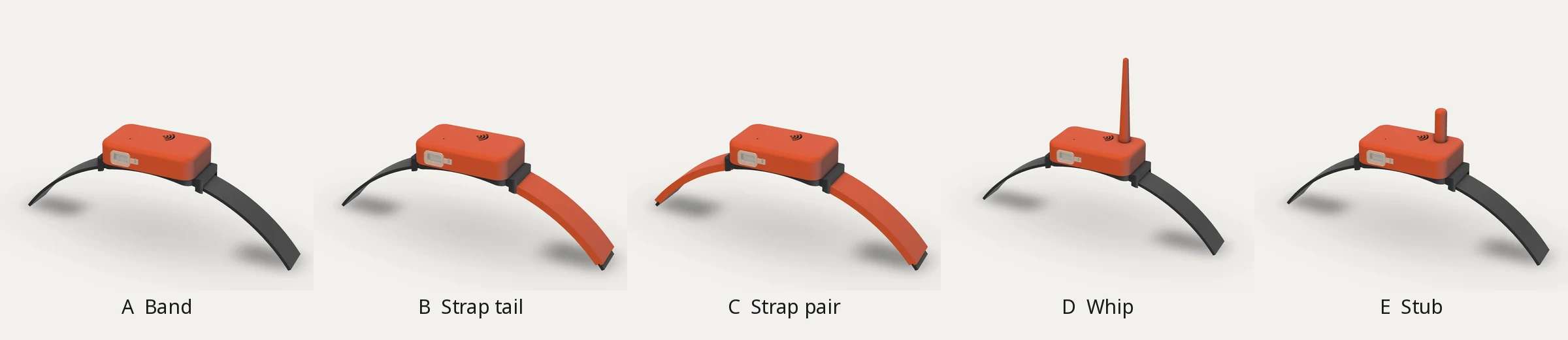
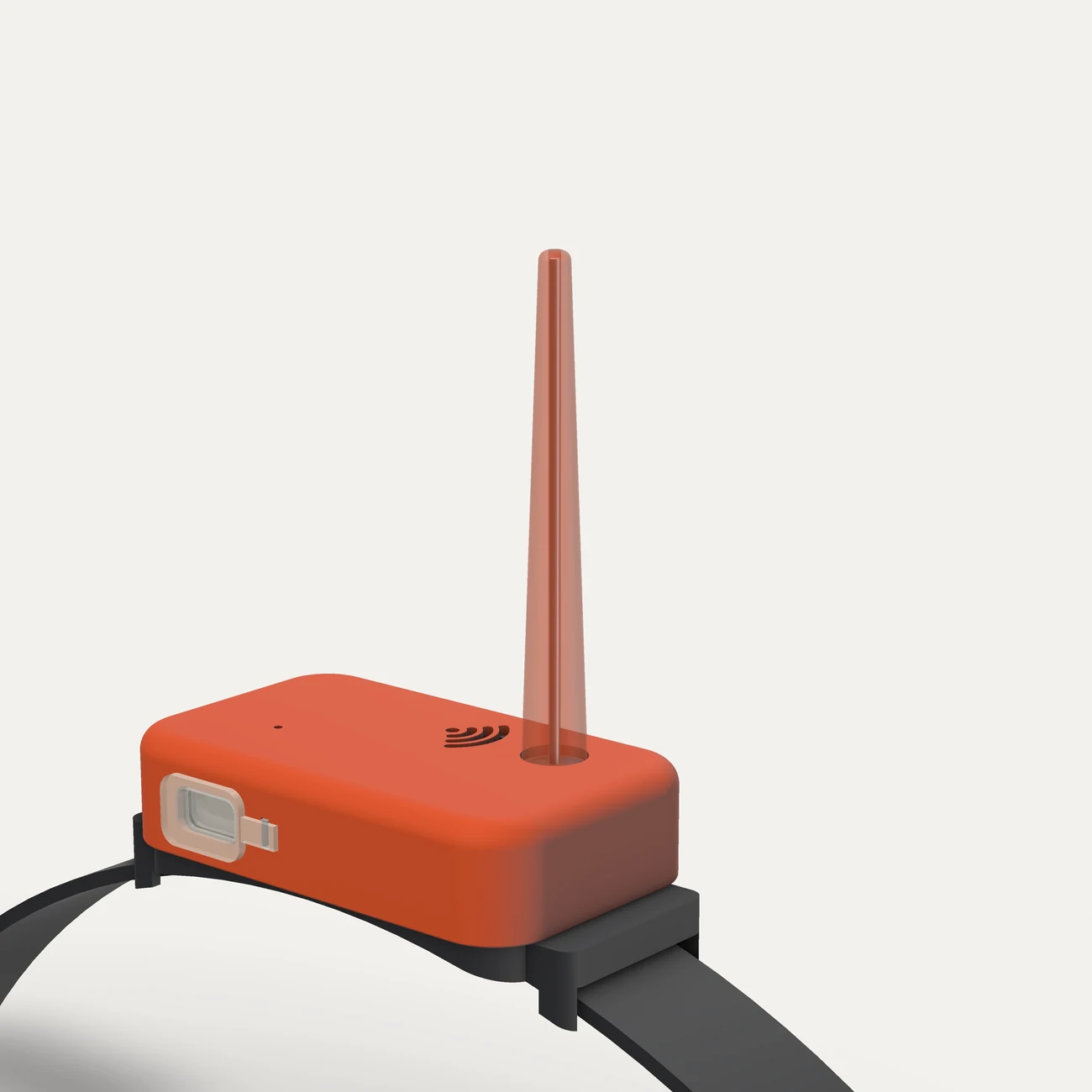
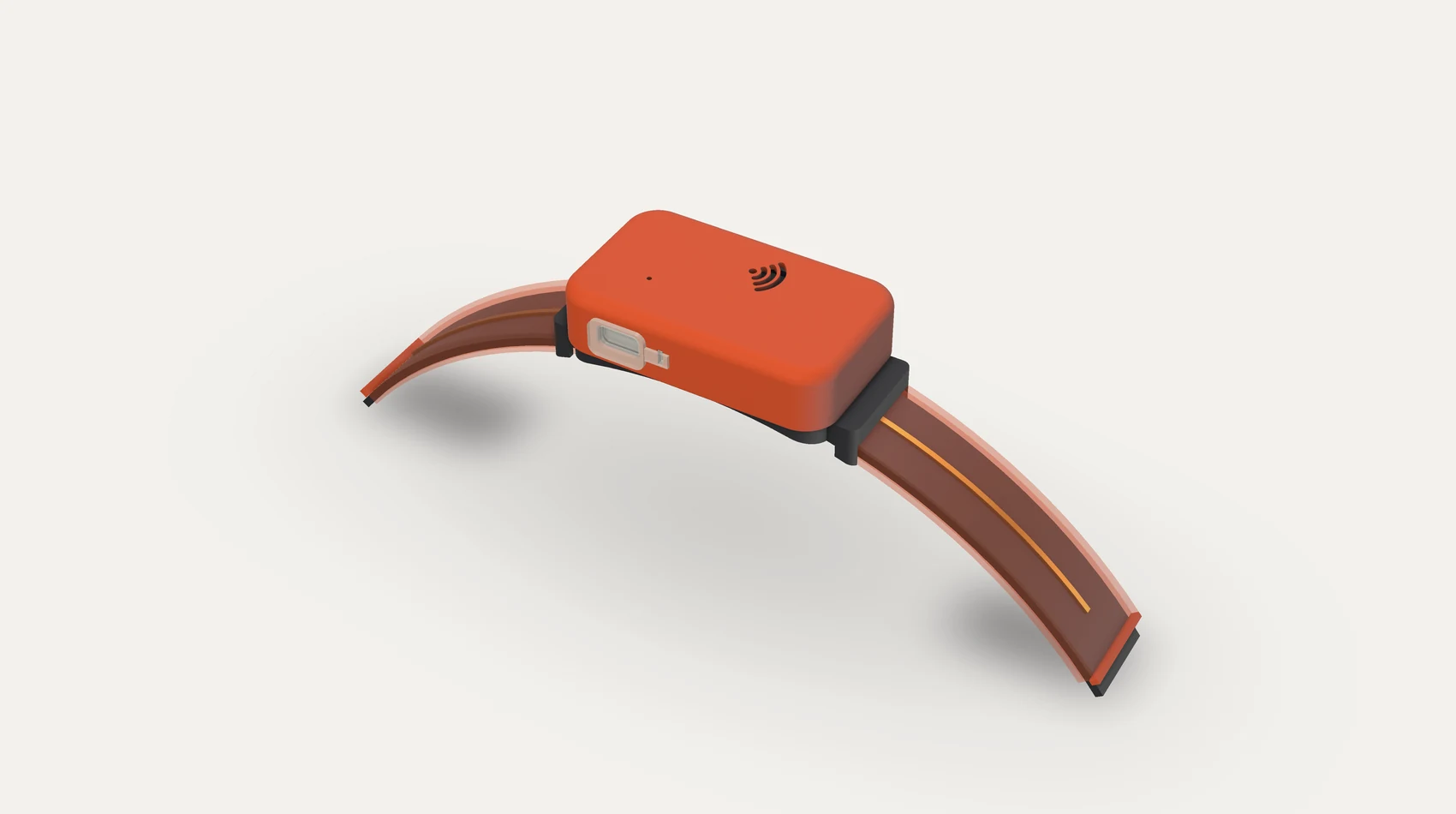
One test collar takes five LoRa antennas, one at a time. It is the collar with three changes: a wire hole in the floor at each end of the box, a neck pad with a hood at each end, and a second lid and bumper with a seat for an upright antenna. Nothing here has been built, tuned or measured, and I have not simulated any of the antennas.
| Antenna | What it is | Extra printed parts | How it joins |
|---|
| A | Band | The collar's own stick-on strip, in the band round the box under the bumper. | Nothing. This is the collar as drawn. | Standard lid and bumper. Plug both wire holes. |
| B | Strap tail | A 78 mm wire along the strap on one side of the box, under a soft sleeve. | One tail sleeve, one sleeve cap. | Solder the wire to the centre of a U.FL lead; leave the lead's braid unconnected at the wire end. Lead the wire down a wire hole, along the pad's channel and into the sleeve. Plug the other hole. |
| C | Strap pair | A 78 mm wire along the strap on each side of the box. | Two tail sleeves, two sleeve caps. | Solder one wire to the centre of a U.FL lead and the other to its braid. One wire goes down each wire hole. |
| D | Whip | A 78 mm length of springy steel wire rope standing up from the lid inside a tapered soft sleeve. | Test lid, test bumper, whip boot. | Solder the wire rope to the centre of a U.FL lead. Pass the rope up through the lid's hole, glue the boot's foot into the lid's pocket with silicone, and fill the hole. Plug both floor holes. |
| E | Stub | A coil about 20 mm long under a short soft cap. | Test lid, test bumper, stub cap. | As the whip, with the coil in place of the wire rope. |
What I expect, and why it needs a test
- The dog's body is the main thing. I found no published measurement on a dog. On people, at this frequency, an antenna worn 8 mm from the body kept about 19 percent of its signal and at 20 mm about 25 percent; about 50 mm away it keeps 60 to 80 percent (Kellomäki, doctoral thesis). The same source reports the tuning shifting by 70 MHz at 10 mm.
- So the whip should reach furthest when the box rides on top of the neck: it is the only option that gets most of its length away from the body. A hunting collar on this band uses a whip (SportDOG TEK 2.0 manual).
- The band, the tail and the pair all lie 3 to 20 mm from the neck, so each may lose three quarters of its signal or more. Which of them loses least is what the test is for.
- A single wire needs something to push against. A quarter-wave wire uses the metal behind it as its other half, and works less well when that is shorter than about 82 mm (Linx, EnOcean). The box and battery are 60 to 78 mm. The strap pair avoids this: it is a full two-wire antenna.
- The whip has costs a test must weigh: another dog can grab it, it can catch on brush, and under the chin it points at the ground.
- These are expectations, not measurements, and none of the antennas has been simulated.
Parts to buy
| Part | What it does | Size | Cost | How sure |
|---|
| One complete collar | The test collar is the collar with a different box, neck pad, lid and bumper. Its other parts are the collar's own | | $71.81 | not checked; my estimate |
| U.FL lead with a bare end, 100 mm (4) | Joins each home-made antenna to the LoRa board's small socket. Antenna A, the band, has its own lead | 1.13 mm cable | $6.00 | not checked; my estimate |
| Copper wire, about 1 mm, 0.5 m | Antennas B and C: one 78 mm length for each strap tail | | $1.00 | not checked; my estimate |
| Stainless steel wire rope, 1/16 in (1.6 mm), 7 x 7 strands, 1 ft | Antenna D: a 78 mm length is the whip. It bends and springs back | | $0.28 | read on the seller's page |
| Adafruit 4269 spring antenna, 915 MHz | Antenna E: the stub | about 17.5 mm long | $0.95 | read on the seller's page |
| MG Chemicals 1035 clear silicone, neutral cure | Seals the wire holes, the sleeve ends and the foot of the whip or stub | | $2.00 | not checked; my estimate; sold by the tube; price not checked |
| Total | | | $82.04 | for the amounts used in one device; packs cost more |
Parts to print
| File (.step and .stl) | Material | Color | Grams | Size, mm | How to lay it on the bed |
|---|
antenna-test-tray | PETG | slate | 16.0 | 77.6 × 44.2 × 15.2 | Open side up. No supports. The collar's box with a wire hole in the floor at each end. |
antenna-test-neck-pad | TPU | slate | 14.2 | 94.0 × 44.2 × 12.4 | Flat side down. The two hoods print as walls; no supports. |
antenna-test-lid | PETG | slate | 5.2 | 77.6 × 44.2 × 1.8 | Outside face down. For the whip and the stub: it has their seat. |
antenna-test-bumper | TPU | blaze orange | 13.7 | 81.2 × 47.8 × 18.8 | Top face down. For the whip and the stub: it has their hole. |
antenna-test-tail-sleeve-92mm | TPU | blaze orange | 6.9 | 92.0 × 28.6 × 6.2 | Print two. Stand it on one long edge, with a brim. |
antenna-test-sleeve-cap | TPU | blaze orange | 0.3 | 6.6 × 28.6 × 2.6 | Print two. Flat face down. |
antenna-test-whip-boot | TPU | blaze orange | 4.2 | 16.0 × 16.0 × 80.8 | Stand it on its foot. No supports. |
antenna-test-stub-cap | TPU | blaze orange | 1.9 | 16.0 × 16.0 × 30.8 | Stand it on its foot. No supports. |
antenna-test-hole-plug | TPU | blaze orange | 0.1 | 5.5 × 5.5 × 7.0 | Print two. Head down. |
| Total | | | 62.5 | | |
The carrier and the port plug are the collar's own files. For antennas A, B and C use the collar's own lid and bumper.
How to compare them
- Fit one antenna. Each joins the same small socket on the LoRa board.
- Pick an open place where you can walk 200 m or more in a straight line. Stand the phone radio on a post at chest height with its antenna straight up. Leave it there for every run.
- Put the collar on the dog, box on top of the neck. Set it to tracking: a report every 2 seconds.
- At a mark 50 m away, stay three and a half minutes (100 reports). Turn the dog to face four ways in that time. The test tool logs how strong each report arrived.
- Do the same at 200 m. Then walk on until fewer than 9 reports in 10 arrive, and note the distance.
- Slide the box under the chin and repeat the 50 m mark.
- Change the antenna and repeat, the same day, in the same place.
| What to write down | A Band | B Tail | C Pair | D Whip | E Stub |
|---|
| Signal at 50 m (average of 100 reports) | | | | | |
| Signal at 200 m | | | | | |
| Furthest point with 9 reports in 10 arriving | | | | | |
| Signal with the box under the chin | | | | | |
| Snags, chewing, comfort | | | | | |
- Average many reports. The radio chip's maker suggests at least a dozen (Semtech); this test uses 100. Count the reports that never arrive as well.
- Keep people away from the phone radio while it logs. A person standing near changes the reading (Texas Instruments DN018).
- A difference under about 3 dB between two antennas is, in my judgment, inside the scatter of a test like this. Treat them as equal and choose on snags and comfort. The radio chip's data sheet states no accuracy for its signal readings.
- 78 mm is a starting length. Wire inside plastic and next to a body usually wants to be a little shorter. An antenna tester shows by how much; without one, test at 78 mm and again with 3 mm cut off.
- The test tool that logs signal strength is stage 0 of the software build order. It is not written yet.
- Before a sale, the antenna that wins has to fit inside the radio module's approval (the kinds of antenna it was tested with, up to 3 dBi) or be approved again.
Printing
- PETG and ASA: 0.2 mm layers, 4 walls, 25 to 40 percent infill. ASA needs the printer's enclosure closed.
- TPU (95A): 3 walls, 100 percent infill for the bumper. On a Bambu printer TPU feeds from the outside spool holder, not through the multi-color unit.
- Every part is one color. The colors come from which filament each part is printed in, so no color changes within a print are needed.
- Faces that show (lid, covers, front panel) go face down on a textured plate.
Battery life, worked out
It is worked out from the makers' data sheets. Nothing is measured. Each case has two figures:
- Calculated uses the data sheets' typical figures and my best assumption for what the software does.
- Plan on is the same sum with cautious inputs, listed below. Use this one until a real collar has been measured.
| Device | Battery | What it is doing | Average draw | Calculated | Plan on |
|---|
| Collar | 1200 mAh | Tracking: a position every 2 seconds | 47 mA | about 22 hours | about 18 hours |
| Collar | 1200 mAh | Walk: a report every 30 seconds | 6.26 mA | about 7 days | about 3 days |
| Collar | 1200 mAh | At home: GPS off, a status report every 5 minutes | 1.93 mA | about 3 weeks | about 13 days |
| Collar | 1200 mAh | At home with bark listening switched off | 0.49 mA | about 3 months | about 9 weeks |
| Small collar | 350 mAh | Tracking: a position every 2 seconds | 47 mA | about 6 hours | about 5 hours |
| Small collar | 350 mAh | Walk: a report every 30 seconds | 6.23 mA | about 2 days | about 19 hours |
| Small collar | 350 mAh | At home: GPS off, a status report every 5 minutes | 1.91 mA | about 7 days | about 4 days |
| Small collar | 350 mAh | At home with bark listening switched off | 0.47 mA | about 4 weeks | about 20 days |
| Light collar | 1200 mAh | Walk, lights on low | 99 mA for the lights | about 10 hours | about 7 hours |
| Light collar | 1200 mAh | Walk, lights on normal | 154 mA for the lights | about 6 hours | about 5 hours |
| Light collar | 1200 mAh | Walk, lights on high | 264 mA for the lights | about 4 hours | about 3 hours |
| Phone radio | 1200 mAh | Switched on, listening all day | 8.18 mA | about 5 days | about 4 days |
| Car monitor | 3 AA lithium cells | On its cells, armed and relaying | 8.05 mA | about 15 days | about 11 days |
| Car monitor | 3 AA lithium cells | On its cells, armed, not relaying | 0.21 mA | about 18 months | about 4 months |
| Home base | none: it stays plugged in | Wi-Fi on, screen on | about 0.6 W (rough) | | |
The collar and the phone radio charge at 100 mA, the most the processor board gives: about 13 hours for 1200 mAh, about 4 hours for the small collar's 350 mAh.
Where the collar's battery goes
Average draw in mA, from the calculated column.
| Load | Tracking | Walk | At home |
|---|
| Processor board asleep | 0.005 | 0.005 | 0.005 |
| Motion sensor counting steps | 0.014 | 0.014 | 0.014 |
| Bluetooth, so the app can find the collar | 0.012 | 0.012 | 0.012 |
| Radio check for a command, once a second | 0.043 | 0.043 | 0.043 |
| Bark listening: microphone and sound input on all the time | 1.4 | 1.4 | 1.4 |
| Battery's own loss | 0.033 | 0.033 | 0.033 |
| GPS on all the time | 41.0 | | |
| A report every 2 seconds | 4.3 | | |
| Processor reading the GPS | 0.099 | | |
| GPS: on for each position, standby between | | 4.4 | |
| A report every 30 seconds | | 0.285 | |
| GPS board on standby | | | 0.360 |
| A status report every 5 minutes | | | 0.022 |
| Total | 46.92 | 6.26 | 1.93 |
What the sums show
- Tracking is the GPS board. It draws 41 of the 47 mA. Sending a report every 2 seconds is 4 mA. Nothing else matters in this mode.
- Walks depend on how long the GPS takes for each position. At 3 seconds a position the collar lasts about 7 days; at 8 seconds, about 3 days. Trees and buildings push it toward the longer figure.
- At home, listening for barks is three quarters of the draw. The microphone and the processor's sound input take about 1.4 mA of 1.9. With bark listening off the collar lasts about 9 weeks in place of about 13 days.
- The GPS board's standby is the next largest at home: 0.36 mA by Seeed's figure for its board, against 0.02 mA that the GPS chip's maker gives for the bare chip. A switch in the GPS board's power lead would remove it.
- An idea, not in the design: wake the microphone only while the collar is moving. The collar already needs sound and movement to agree before it counts a bark. That would give about 4 weeks at home with bark listening still on, if a dog at home moves about a third of the time. It may miss the first bark of a spell. It needs a test.
- Against the earlier targets (12 hours, 3 days, 17 days): tracking is better at about 18 hours, walks are the same at about 3 days, and home is lower at about 13 days.
- The small collar draws the same and holds 350 mAh, so it lasts under a third as long.
- The car monitor lasts about 11 days on its cells because relaying means listening all the time. Not relaying, it lasts about 4 months or more. On the car's USB socket none of this matters.
What each use costs
These are on top of the averages above.
- One 2-second voice clip: 0.06 to 0.13 mAh. A hundred clips is about 1 percent of the collar's battery.
- One second of vibration: 0.02 mAh.
- One command, or a burst of commands: 0.02 mAh, mostly the 10 seconds of listening that follows it.
- Lights (light collar): 99, 154 or 264 mA on low, normal or high. An hour's walk on normal uses about 21 percent of a charge. A dark strip left powered would draw 44 mA, which is why its power is switched off.
The cautious inputs
- Usable share of the battery's rated capacity: 75% in place of 85% (cut-off voltage, age, cold).
- Sleeping currents: 3 times the data-sheet figure.
- GPS running time for each position on a walk: 8 seconds in place of 3.
- Bark listening: the microphone at full rate and the processor's sound input at its sister chip's figure, 2.4 mA in place of 1.4.
- Radio: 15% of reports sent twice; a listen of 40 ms after each report in place of 20; the once-a-second check twice as long.
- The battery's own loss: 4% a month in place of 2%.
- Car monitor: 0.5 mA added for the board's charger chip, which sits powered with no rechargeable battery fitted. I found no figure for it.
Figures used
| What | Figure | Read in | How sure |
|---|
| Processor running | 3.3 mA | Nordic nRF52840 product specification, section 5.2.1 | maker's document |
| Processor board asleep: Seeed says "less than 5 uA"; the processor itself is 0.003 mA with its clock running | 0.005 mA | Seeed XIAO nRF52840 page | maker's document |
| Motion sensor, low-power mode at 26 readings a second (the data sheet gives 0.009 mA at 12.5; the 26 figure is from a summary of ST's note) | 0.014 mA | ST LSM6DS3TR-C data sheet, table 4 | second-hand |
| Microphone in its low-power mode | 0.29 mA | MEMSensing MSM261D3526H1CPM data sheet | maker's document |
| Microphone at full rate | 0.67 mA | MEMSensing MSM261D3526H1CPM data sheet | maker's document |
| Processor's sound input with its fast clock. Nordic gives no figure for this chip; its sister chip's is 1.4 mA | 1 mA | Nordic nRF52832 product specification, PDM | my estimate |
| Bluetooth announcing itself every 2 seconds, so the app can find the collar close by | 0.012 mA | my estimate from the radio's 6.4 mA send current, about 4 ms per announcement | my estimate |
| Bluetooth link to the phone, held open | 0.2 mA | my estimate; Nordic's online calculator could not be run | my estimate |
| LoRa board asleep | 0.0016 mA | Seeed Wio-SX1262 module data sheet | maker's document |
| LoRa board receiving (the bare chip is 4.6 to 5.3 mA; the board adds its oscillator) | 7.6 mA | Seeed Wio-SX1262 module data sheet | maker's document |
| LoRa board sending at full power, +22 dBm | 125 mA | Seeed Wio-SX1262 module data sheet | maker's document |
| LoRa board waking: chip 0.8 mA, oscillator 1.5 mA | 2.3 mA | Semtech SX1261/2 data sheet, tables 3-5 and 3-7 | maker's document |
| Time the LoRa board's oscillator needs before each check (the usual software setting) | 5 ms | RadioLib source, default oscillator delay | second-hand |
| GPS board finding or tracking satellites, with its antenna (the bare module is 29 mA) | 41 mA | Seeed L76K board page | maker's document |
| GPS board on standby (Quectel gives 0.02 mA for the bare module; Seeed's board figure is used) | 0.36 mA | Seeed L76K board page | maker's document |
| GPS: time to a position when woken from standby | 2 s | Quectel L76K hardware design, table 2 | maker's document |
| Amplifier, powered but silent | 4 mA | Diodes PAM8302A data sheet | maker's document |
| Amplifier efficiency | 0.85 | Diodes PAM8302A data sheet | maker's document |
| Vibration motor (60 mA at 3 V; 75 mA is the motor sheet's limit) | 75 mA | Adafruit 1201 page and motor sheet | maker's document |
| One light, powered but dark | 1 mA | SK6812RGBW data sheet | maker's document |
| One color of one light, fully on (80 mA with all four on) | 20 mA | Adafruit RGBW strip page | maker's document |
| One AA lithium cell at 25 mA, read off Energizer's chart | 3200 mAh | Energizer L91 data sheet | maker's document |
| LiPo's own loss: the cell's maker says over 80 percent is left after 28 days; Battery University gives 1 to 2 percent a month plus 3 for the safety circuit | 0.02 per month | PKCELL LP-503562 specification | second-hand |
| Home base board with Wi-Fi on (screen not included; Heltec gives no figure) | 105 mA | Heltec HT-VMT190 data sheet, table 3.2 | maker's document |
| Custom board: GPS receiver tracking (9.5 + 2.3 mA) | 11.8 mA | u-blox MAX-M10S data sheet | maker's document |
| Custom board: GPS receiver switched off but keeping its memory, so it restarts in a second | 0.028 mA | u-blox MAX-M10S data sheet | maker's document |
| Custom board: microphone waiting for a loud sound | 0.02 mA | TDK T5838 data sheet | maker's document |
| Custom board: microphone recording | 0.31 mA | TDK T5838 data sheet | maker's document |
| Custom board: motion sensor, low-power mode at 60 readings a second | 0.017 mA | ST LSM6DSV16X data sheet | maker's document |
| Custom board asleep: module 0.0042, charger 0.003, memory 0.001, supplies under 0.0003 | 0.0085 mA | RAKwireless RAK4630 data sheet; TI BQ25180, TPS62840, TPS7A02; Winbond W25Q32JV | maker's document |
Not checked yet
- Nothing is built or tested. Fit, sealing, sound, vibration through fur, battery life and radio range are all unproven.
- Seeed board stack size. Seeed gives 21 x 17.8 mm in one place and 8 x 22 x 23 mm in another, with no drawing. Every housing leaves 22 x 23 x 8 mm. Measure the real boards before printing.
- GPS antenna size. Seeed does not publish it. The collar allows 15 x 15 x 6 mm.
- The two pads on the underside of the processor board (NFC1, NFC2) need a setting before they work as ordinary pins. Not tried.
- Sound. Voice from one pin through the amplifier, and clip storage in the board's own memory, are designed but not tried.
- Water. The speaker's maker rates its front face IPX7; distributors still say IP67. The lid cord, the plug and the microphone membrane are untested. The plug is the weak point for swimming.
- Antennas. The collar's strip sits near the battery and the dog's neck, which shifts its tuning. The phone radio's two wires should be trimmed with an antenna analyser for best range. No range figure exists yet.
- Phone radio and the phone. With the blade straight up it stands in the area Apple asks case makers to keep clear of metal, and beside the flash. The hold through a case depends on the case having its own magnets.
- Car monitor power. Three fresh lithium cells give up to 5.5 V and the board's 5 V pin allows 5.5 V, so the diode is required. Seeed's page for this board does not describe feeding the 5 V pin; the limits come from Seeed's schematic and the chip makers' data sheets. The charge light may flicker with no rechargeable battery fitted.
- Car monitor reading. How fast the sensor follows the cabin from inside its channel is not measured.
- Home base. The screen's place on the board is scaled from Heltec's drawing, good to about 1 mm. Powering the board through its 5 V pin, and the USB-C socket board's size, are not checked.
- Antenna lead. Adafruit's page for part 851 says SMA; its drawing says RP-SMA. Check it against the antenna before ordering both.
- Prices. Rows marked second-hand or not checked are not from the seller's own page.
- Printing. The files are valid solids but have not been through a slicer.
- FCC. Radio approval is needed before any sale. Not started.
- Battery life. Every figure is worked out from data sheets. The largest unknowns: how long the GPS runs for each position, the processor's draw while it listens for barks (Nordic gives no figure for this chip), and how low the whole board sleeps.
- Small collar. Who it fits is my estimate. The GPS antenna sits on a shelf 0.1 mm above the GPS board's tallest part; if the real board is taller than Seeed's figure the shelf must rise. Two M2 screws hold it to the strap, which is less than the collar's two M3.
- Light collar. How even the light looks through the sleeve: a common rule asks for the lights to sit further from the cover than they are from each other (7 mm), and here they are about 4 mm, so expect soft dots. The strip's maker gives figures only at 4.5 to 5.5 V; it runs here at 3.5 to 4.2 V. The strip's dimming rate is 1.2 kHz by its chip's data sheet and 400 Hz by Adafruit's page; a dog is said to see flicker up to about 80 Hz, so neither should show while still, but fast movement may look speckled. The power switch board's draw when off was not found. The sleeve's seal is silicone at both ends and is untested.
- Sizes of small batteries. Shop pages and data sheets disagree, and the data sheet is usually larger. The small collar and both custom-board collars are sized to the data sheet.
- Custom board. See the list at the end of its section. The layout is not drawn.
- Antennas. None is built, tuned, simulated or measured. The test tool that logs signal strength is not written.
Sources
- Apple, Accessory Design Guidelines for Apple Devices, R32 Update 1, section 41.2
- Apple, iPhone 18 Pro Max dimensional drawing
- Heltec, Vision Master T190 data sheet
- Seeed, XIAO nRF52840 schematic
- Nordic, nRF52840 product specification (5 V pin limits)
- Energizer, L91 data sheet
- Battery University, charging at high and low temperatures
- U.S. Fire Administration, battery fire safety
- Diodes Inc., PAM8302A data sheet
- CNC Kitchen, heat-set insert sizes
- Seeed, XIAO nRF52840 Sense Plus
- Opsco, SK6812RGBW light data sheet
- Adafruit, powering NeoPixel lights from a battery
- Flicker in dogs, about 80 Hz (PLOS ONE 2024, citing earlier work)
- Diffuser distance rule, measured channel test
- RAKwireless, RAK4630 module data sheet
- FCC grant record for the RAK4630
- FCC rule 15.212, modular transmitters
- FCC rule 15.204, antennas
- u-blox, MAX-M10S data sheet
- TDK, T5838 microphone
- Taoglas, 15 mm GPS antenna data sheet
- GCT, USB4720 socket drawing
- US Customs rule suspending the low-value import exemption
- Kellomaki, effects of the human body on wearable antennas (thesis)
- Linx, antenna basics (AN-00500)
- Semtech, testing devices that use LoRa
- Meshtastic, device roles
- American Kennel Club, choosing a collar
- Tractive, which tracker for which pet (sizes and weights)
- AVMA, Pets in vehicles
- McLaren, Null, Quinn, Pediatrics 2005
- Cornell University, heatstroke in dogs